

Surah Rahman in English Transliteration is a beautiful and profound chapter of the Qur’an, often referred to as the “Bride of the Qur’an” due to its eloquence and poetic rhythm. It is the 55th chapter, consisting of 78 verses, and was revealed in Madinah. The Surah is named after one of the most beautiful names of Allah, “Ar-Rahman,” which translates to “The Most Merciful.” This chapter vividly describes the countless blessings and signs of Allah’s mercy that are evident in creation, emphasizing gratitude and recognition of divine power. For those interested in exploring more beautiful chapters of the Quran, you can also read Surah Al-Mulk in English transliteration.
What is Surah Rahman? surah ar rahman explanation
Surah Ar-Rahman is a declaration of Allah’s limitless mercy and generosity. It repeatedly asks the question, “Fabi ayyi ala’i Rabbikuma tukazziban?” which means, “Then which of the favors of your Lord will you deny?” This recurring verse reminds mankind and jinn of the innumerable blessings they enjoy. Surah Ar-Rahman describes the perfect balance in creation, the wonders of nature, and the ultimate accountability in the Hereafter.
Surah Ar-Rahman:
Surah Ar-Rahman is the melody of mercy and beauty.
Let its repeated question “Which of your Lord’s favors will you deny?” live in your heart.

Come back anytime to Arabic-OM.com – where every verse soothes your soul.
Full Surah Rahman in English Transliteration: surah rahman in roman english
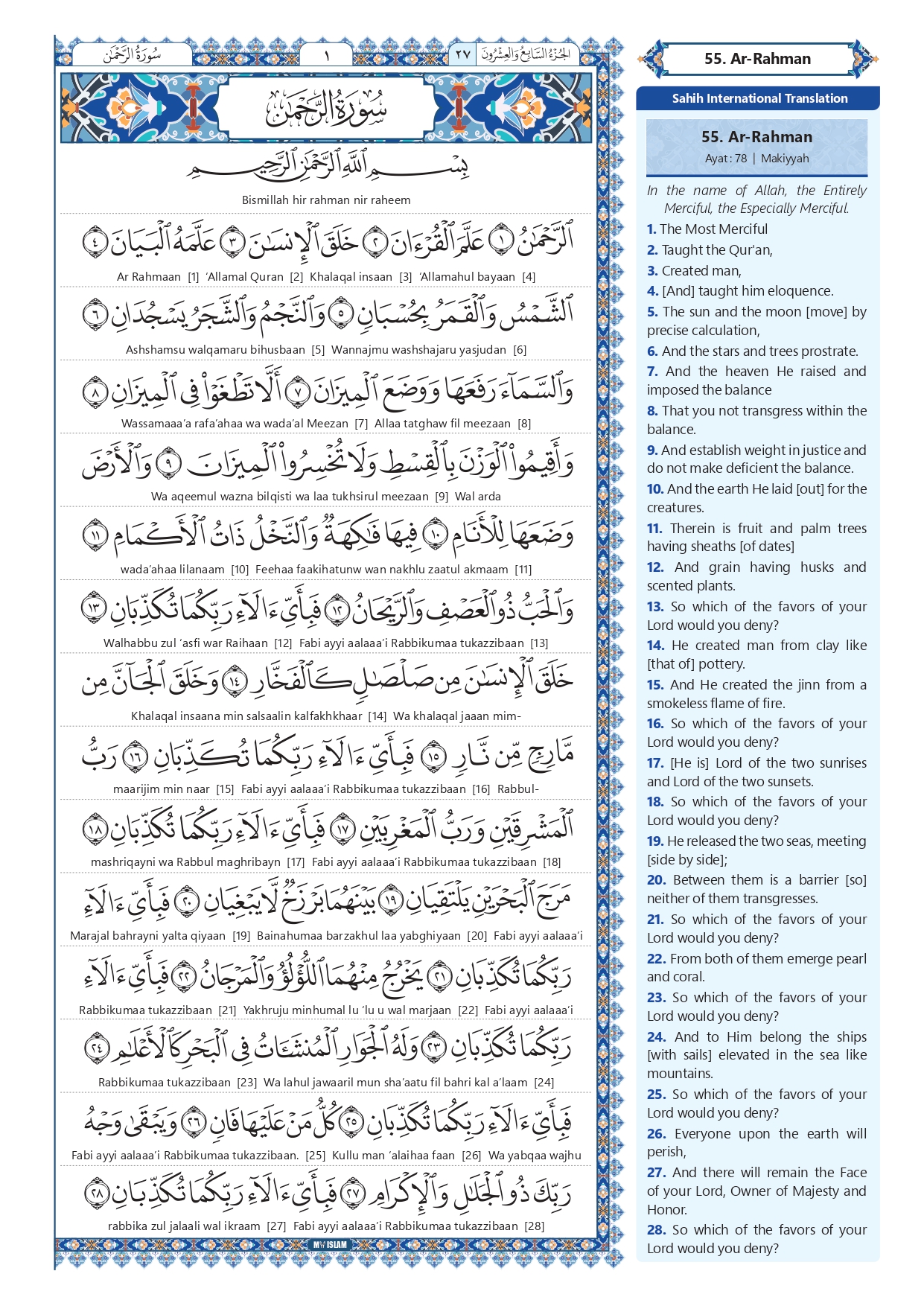
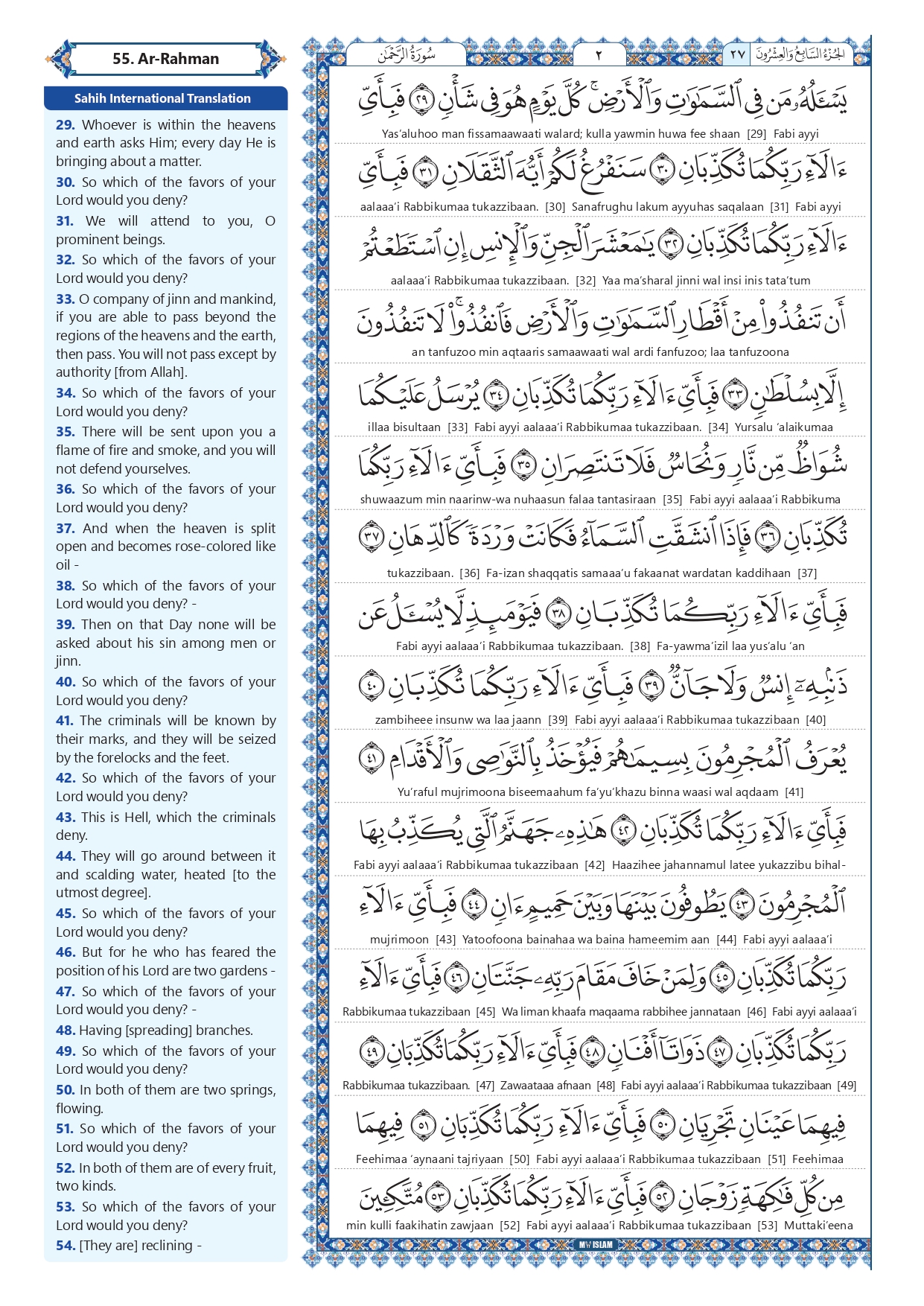
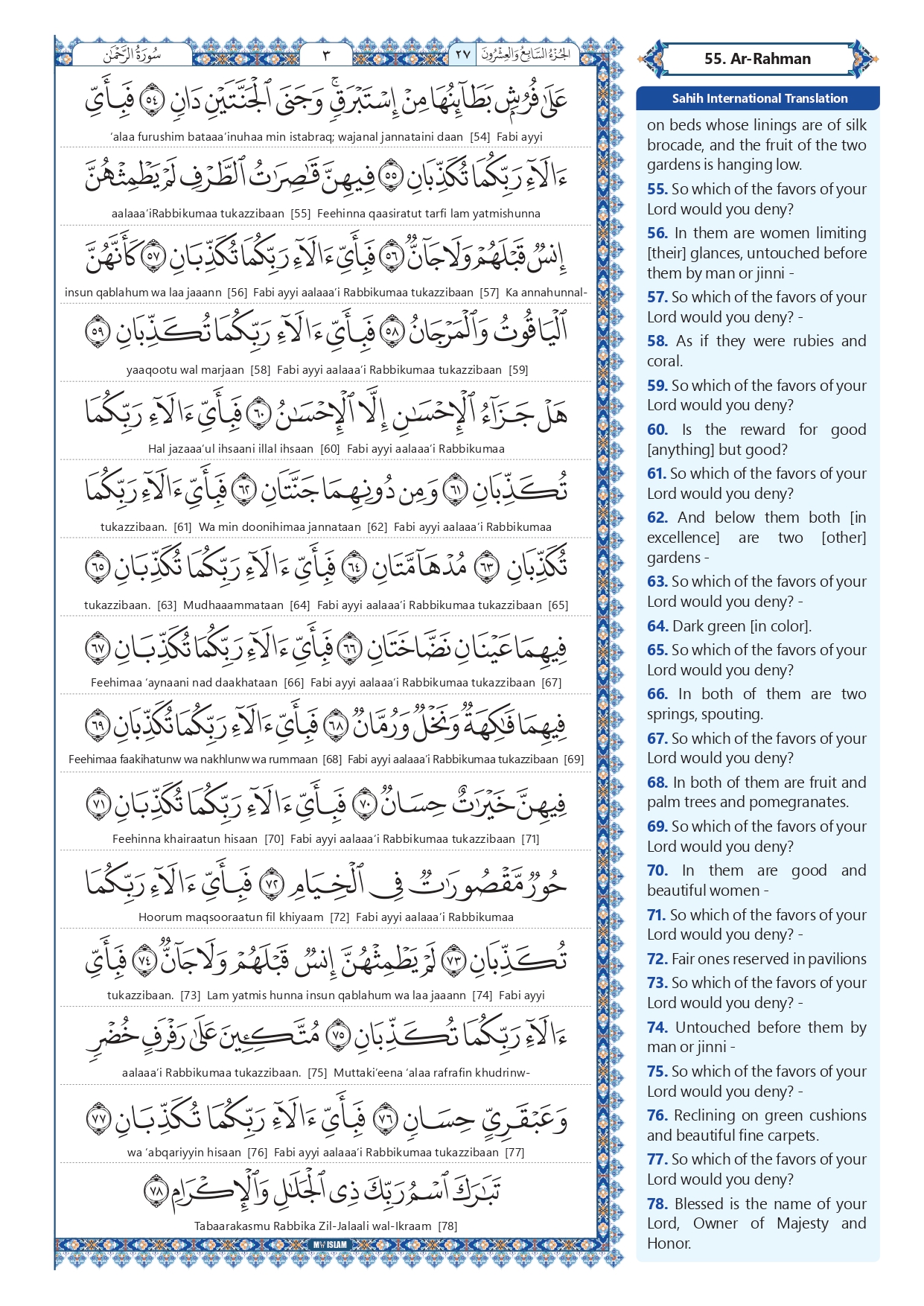
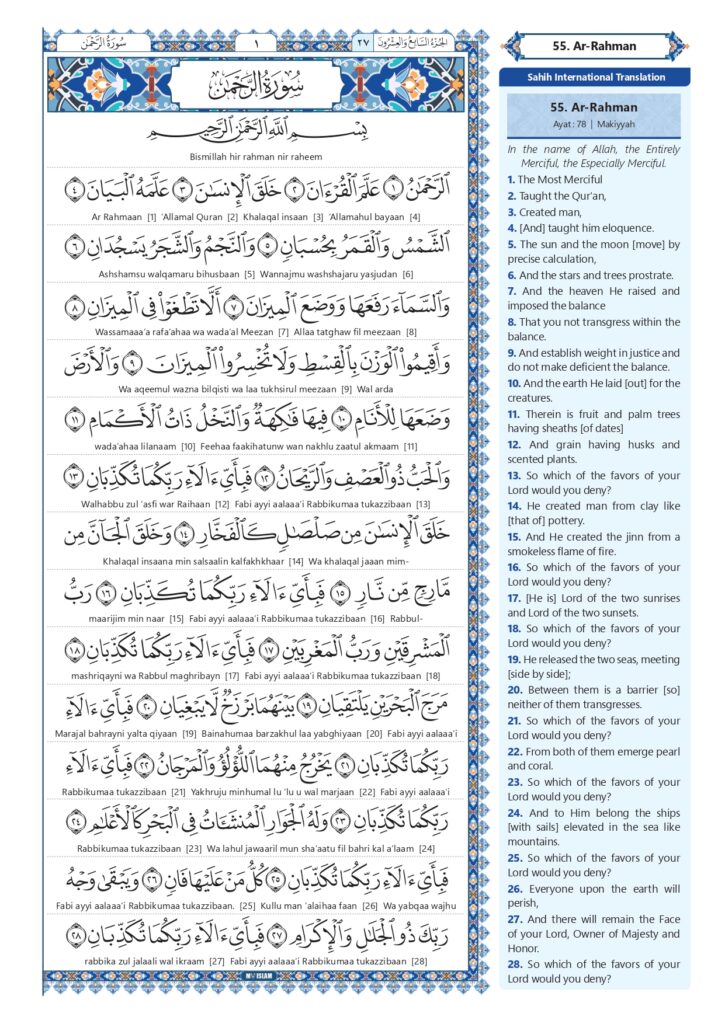
Surah Rahman in English Transliterationtext in arabic and in English
A’uthu billahi min ash-shaytan ir-rajim
Bismillahir Rahmanir Raheem
١. الرَّحْمَـٰنُ
Ar-Rahmaan
The Most Merciful
٢. عَلَّمَ الْقُرْآنَ
‘Allamal-Qur’aan
Taught the Qur’an
٣. خَلَقَ الْإِنسَانَ
Khalaqal-insaan
Created man
٤. عَلَّمَهُ الْبَيَانَ
‘Allamahul-bayaan
[And] taught him clear expression
٥. الشَّمْسُ وَالْقَمَرُ بِحُسْبَانٍ
Ash-shamsu wal-qamaru bihusbaan
The sun and the moon [move] by precise calculation
٦. وَالنَّجْمُ وَالشَّجَرُ يَسْجُدَانِ
Wan-najmu wash-shajaru yasjudaan
And the stars and trees prostrate
٧. وَالسَّمَاءَ رَفَعَهَا وَوَضَعَ الْمِيزَانَ
Was-samaa’a rafa’ahaa wa wada’al-meezaan
And the heaven He raised and imposed the balance
٨. أَلَّا تَطْغَوْا فِي الْمِيزَانِ
Allaa tatghaw fil-meezaan
That you not transgress within the balance
٩. وَأَقِيمُوا الْوَزْنَ بِالْقِسْطِ وَلَا تُخْسِرُوا الْمِيزَانَ
Wa aqeemul-wazna bil-qist wa laa tukhsirul-meezaan
And establish weight in justice and do not make deficient the balance
١٠. وَالْأَرْضَ وَضَعَهَا لِلْأَنَامِ
Wal-arda wada’ahaa lil-anaam
And the earth He laid out for the creatures
١١. فِيهَا فَاكِهَةٌ وَالنَّخْلُ ذَاتُ الْأَكْمَامِ
Feehaa faakihatun wan-nakhlu dhaatul-akmaam
Therein is fruit and palm trees having sheaths [of dates]
١٢. وَالْحَبُّ ذُو الْعَصْفِ وَالرَّيْحَانُ
Wal-habbu dhul-‘asfi war-rayhaan
And grain having husks and scented plants
١٣. فَبِأَيِّ آلَاءِ رَبِّكُمَا تُكَذِّبَانِ
Fa-bi ayyi aalaaa’i rabbikumaa tukaththibaan
So which of the favors of your Lord will you [two] deny?
١٤. خَلَقَ الْإِنسَانَ مِن صَلْصَالٍ كَالْفَخَّارِ
Khalaqal-insaana min salsaalin kalfakhaar
He created man from clay like [that of] pottery
١٥. وَخَلَقَ الْجَانَّ مِن مَّارِجٍ مِّن نَّارٍ
Wa khalaqal-jaanna mim maarijin min naar
And He created the jinn from a smokeless flame of fire
١٦. فَبِأَيِّ آلَاءِ رَبِّكُمَا تُكَذِّبَانِ
Fa-bi ayyi aalaaa’i rabbikumaa tukaththibaan
So which of the favors of your Lord will you [two] deny?
١٧. رَبُّ الْمَشْرِقَيْنِ وَرَبُّ الْمَغْرِبَيْنِ
Rabbu-l-mashriqayni wa rabbu-l-maghribayn
[He is] Lord of the two sunrises and Lord of the two sunsets
١٨. فَبِأَيِّ آلَاءِ رَبِّكُمَا تُكَذِّبَانِ
Fa-bi ayyi aalaaa’i rabbikumaa tukaththibaan
So which of the favors of your Lord will you [two] deny?
١٩. مَرَجَ الْبَحْرَيْنِ يَلْتَقِيَانِ
Marajal-bahrayni yaltaqiyaan
He released the two seas, meeting [side by side]
٢٠. بَيْنَهُمَا بَرْزَخٌ لَّا يَبْغِيَانِ
Baynahumaa barzakhul laa yabghiyaan
Between them is a barrier [so] neither of them transgresses
٢١. فَبِأَيِّ آلَاءِ رَبِّكُمَا تُكَذِّبَانِ
Fa-bi ayyi aalaaa’i rabbikumaa tukaththibaan
So which of the favors of your Lord will you [two] deny?
٢٢. يَخْرُجُ مِنْهُمَا اللُّؤْلُؤُ وَالْمَرْجَانُ
Yakhruju minhumaa al-lu’lu’u wal-marjaan
From both of them emerge pearl and coral
٢٣. فَبِأَيِّ آلَاءِ رَبِّكُمَا تُكَذِّبَانِ
Fa-bi ayyi aalaaa’i rabbikumaa tukaththibaan
So which of the favors of your Lord will you [two] deny?
٢٤. وَلَهُ الْجَوَارِ الْمُنشَآتُ فِي الْبَحْرِ كَالْأَعْلَامِ
Wa lahul-jawaari al-munsha’aatu fil-bahri kal-a’laam
And to Him belong the ships elevated in the sea like mountains
٢٥. فَبِأَيِّ آلَاءِ رَبِّكُمَا تُكَذِّبَانِ
Fa-bi ayyi aalaaa’i rabbikumaa tukaththibaan
So which of the favors of your Lord will you [two] deny?
٢٦. كُلُّ مَنْ عَلَيْهَا فَانٍ
Kullu man ‘alayhaa faan
Everyone upon it will perish
٢٧. وَيَبْقَىٰ وَجْهُ رَبِّكَ ذُو الْجَلَالِ وَالْإِكْرَامِ
Wa yabqaa wajhu rabbika dhul-jalaali wal-ikraam
And the Face of your Lord, full of Majesty and Honor, will remain
٢٨. فَبِأَيِّ آلَاءِ رَبِّكُمَا تُكَذِّبَانِ
Fa-bi ayyi aalaaa’i rabbikumaa tukaththibaan
So which of the favors of your Lord will you [two] deny?
٢٩. يَسْأَلُهُ مَن فِي السَّمَاوَاتِ وَالْأَرْضِ ۚ كُلَّ يَوْمٍ هُوَ فِي شَأْنٍ
Yas’aluhoo man fis-samaawaati wal-ard; kulla yawmin huwa fee shaan
Whoever is in the heavens and earth asks Him; every day He is bringing about a matter
٣٠. فَبِأَيِّ آلَاءِ رَبِّكُمَا تُكَذِّبَانِ
Fa-bi ayyi aalaaa’i rabbikumaa tukaththibaan
So which of the favors of your Lord will you [two] deny?
٣١. سَنَفْرُغُ لَكُمْ أَيُّهَا الثَّقَلَانُ
Sanafrughu lakum ayyuhath-thaqalaan
We will attend to you, O prominent beings.
٣٢. فَبِأَيِّ آلَاءِ رَبِّكُمَا تُكَذِّبَانِ
Fa-bi ayyi aalaaa’i rabbikumaa tukaththibaan
So which of the favors of your Lord will you [two] deny?
٣٣. يَا مَعْشَرَ الْجِنِّ وَالْإِنْسِ إِنِ اسْتَطَعْتُمْ أَنْ تَنْفُذُوا مِنْ أَقْطَارِ السَّمَاوَاتِ وَالْأَرْضِ فَانْفُذُوا لَا تَنفُذُونَ إِلَّا بِسُلْطَانٍ
Yaa ma’sharal-jinni wal-insi in istat’tum an tanfuthoo min aqtaaris-samaawaati wal-ard fanfuthoo laa tanfudhoona illa bisultaan
O company of jinn and mankind, if you are able to pass beyond the regions of the heavens and the earth, then pass. You will not pass except by authority.
٣٤. فَبِأَيِّ آلَاءِ رَبِّكُمَا تُكَذِّبَانِ
Fa-bi ayyi aalaaa’i rabbikumaa tukaththibaan
So which of the favors of your Lord will you [two] deny?
٣٥. يُرْسَلُ عَلَيْكُمَا شُوَاظٌ مِن نَّارٍ وَنُحَاسٌ فَلَا تَنتَصِرَانِ
Yursalu ‘alaykuma shuwaazum min naarin wanuhaasun falaa tantasiraan
Sent upon you both will be a flame of fire, and smoke, and you will not defend yourselves.
٣٦. فَبِأَيِّ آلَاءِ رَبِّكُمَا تُكَذِّبَانِ
Fa-bi ayyi aalaaa’i rabbikumaa tukaththibaan
So which of the favors of your Lord will you [two] deny?
٣٧. وَلِمَن خَافَ مَقَامَ رَبِّهِ جَنَّتَانِ
Wa liman khaafa maqaama rabbihi jannataan
But for he who has feared the position of his Lord are two gardens.
٣٨. فَبِأَيِّ آلَاءِ رَبِّكُمَا تُكَذِّبَانِ
Fa-bi ayyi aalaaa’i rabbikumaa tukaththibaan
So which of the favors of your Lord will you [two] deny?
٣٩. ذَوَاتَا أَفْنَانٍ
Dhaataaa afnaan
[Both] containing lush branches.
٤٠. فَبِأَيِّ آلَاءِ رَبِّكُمَا تُكَذِّبَانِ
Fa-bi ayyi aalaaa’i rabbikumaa tukaththibaan
So which of the favors of your Lord will you [two] deny?
٤١. فِيهِمَا عَيْنَانِ نَضَّاخَتَانِ
Fīhimā ‘aynāni naḍḍākhatān
In both [gardens] are two springs, flowing.
٤٢. فَبِأَيِّ آلَاءِ رَبِّكُمَا تُكَذِّبَانِ
Fa-bi ayyi ālā’i rabbikumā tukadhdhibān
So which of the favors of your Lord will you [both] deny?
٤٣. فِيهِمَا مِن كُلِّ فَاكِهَةٍ زَوْجَانِ
Fīhimā min kulli fākihatin zawjān
In both are fruit from which the two [gardens] produce.
٤٤. فَبِأَيِّ آلَاءِ رَبِّكُمَا تُكَذِّبَانِ
Fa-bi ayyi ālā’i rabbikumā tukadhdhibān
So which of the favors of your Lord will you [both] deny?
٤٥. فَبِأَيِّ ءَالَآءِ رَبِّكُمَا تُكَذِّبَانِ
Fa-bi ayyi ālā’i rabbikumā tukadhdhibān
So which of the favors of your Lord will you both deny?
٤٦. وَلِمَنْ خَافَ مَقَامَ رَبِّهِۦ جَنَّتَانِ
Wa liman khāfa maqāma rabbihi jannatān
But for he who has feared the position of his Lord are two gardens —
٤٧. فَبِأَيِّ ءَالَآءِ رَبِّكُمَا تُكَذِّبَانِ
Fa-bi ayyi ālā’i rabbikumā tukadhdhibān
So which of the favors of your Lord will you both deny?
٤٨. ذَوَاتَآ أَفۡنَانٖ
Dhawātā afnān
(They are) two (gardens) with spreading branches.
٤٩. فَبِأَيِّ ءَالَآءِ رَبِّكُمَا تُكَذِّبَانِ
Fa-bi ayyi ālā’i rabbikumā tukadhdhibān
So which of the favors of your Lord will you both deny?
٥٠. فِيهِمَا عَيۡنَانِ تَجۡرِيَانِ
Fīhimā ‘aynāni tajriyān
In both are two springs flowing.
٥١. فَبِأَيِّ ءَالَآءِ رَبِّكُمَا تُكَذِّبَانِ
Fa-bi ayyi ālā’i rabbikumā tukadhdhibān
So which of the favors of your Lord will you both deny?
٥٢. فِيهِمَا مِن كُلِّ فَاكِهَةٍ زَوۡجَانِ
Fīhimā min kulli fākihatin zawjān
In both are fruit from every (kind) — a pair.
٥٣. فَبِأَيِّ ءَالَآءِ رَبِّكُمَا تُكَذِّبَانِ
Fa-bi ayyi ālā’i rabbikumā tukadhdhibān
So which of the favors of your Lord will you both deny?
٥٤. مُتَّكِـِٔينَ عَلَىٰ فُرُشٍۭ بَطَآئِنُهَا مِنۡ إِسۡتَبۡرَقٖۚ وَجَنَى ٱلۡجَنَّتَيۡنِ دَانٍ
Muttaki’īna ‘alā furushin baṭā’inuhā min istabrāq; wa janā al-jannatayni dān
[They are] reclining on beds whose linings are of silk brocade, and the fruit of the two gardens is hanging low.
٥٥. فَبِأَيِّ ءَالَآءِ رَبِّكُمَا تُكَذِّبَانِ
Fa-bi ayyi ālā’i rabbikumā tukadhdhibān
So which of the favors of your Lord will you both deny?
٥٦. فِيهِنَّ قَٰصِرَٰتُ ٱلطَّرۡفِ لَمۡ يَطۡمِثۡهُنَّ إِنسٞ قَبۡلَهُمۡ وَلَا جَآنّٞ
Fīhinna qāṣirātu al-ṭarfi lam yaṭmithhunna insun qablahum wa-lā jān
In them are women limiting [their] glances, untouched before them by man or jinni.
٥٧. فَبِأَيِّ ءَالَآءِ رَبِّكُمَا تُكَذِّبَانِ
Fa-bi ayyi ālā’i rabbikumā tukadhdhibān
So which of the favors of your Lord will you both deny?
٥٨. كَأَنَّهُنَّ ٱلۡيَاقُوتُ وَٱلۡمَرۡجَانُ
Ka-annahunna al-yāqūtu wa-l-marjān
As if they were rubies and coral.
٥٩. فَبِأَيِّ ءَالَآءِ رَبِّكُمَا تُكَذِّبَانِ
Fa-bi ayyi ālā’i rabbikumā tukadhdhibān
So which of the favors of your Lord will you both deny?
٦٠. هَلۡ جَزَآءُ ٱلۡإِحۡسَٰنِ إِلَّا ٱلۡإِحۡسَٰنُ
Hal jazā’u al-iḥsāni illā al-iḥsān
Is the reward for good [anything] but good?
٦١. فَبِأَيِّ ءَالَآءِ رَبِّكُمَا تُكَذِّبَانِ
Fa-bi ayyi ālā’i rabbikumā tukadhdhibān
So which of the favors of your Lord will you both deny?
٦٢. وَمِن دُونِهِمَا جَنَّتَانِ
Wa min dūnihimā jannatān
And below them [in excellence] are two [other] gardens.
٦٣. فَبِأَيِّ ءَالَآءِ رَبِّكُمَا تُكَذِّبَانِ
Fa-bi ayyi ālā’i rabbikumā tukadhdhibān
So which of the favors of your Lord will you both deny?
٦٤. مُدۡهَآمَّتَانِ
Mud’hāmmatan
Dark green [in color].
٦٥. فَبِأَيِّ ءَالَآءِ رَبِّكُمَا تُكَذِّبَانِ
Fa-bi ayyi ālā’i rabbikumā tukadhdhibān
So which of the favors of your Lord will you both deny?
٦٦. فِيهِمَا عَيۡنَانِ نَضَّاخَتَانِ
Fīhimā ʿaynāni naḍḍākhatan
In both of them are two springs, gushing.
٦٧. فَبِأَيِّ ءَالَآءِ رَبِّكُمَا تُكَذِّبَانِ
Fa-bi ayyi ālā’i rabbikumā tukadhdhibān
So which of the favors of your Lord will you both deny?
٦٨. فِيهِمَا فَٰكِهَةٞ وَنَخۡلٞ وَرُمَّانٞ
Fīhimā fākihatun wa-nakhlun wa-rummān
In both of them are fruit and palm trees and pomegranates.
٦٩. فَبِأَيِّ ءَالَآءِ رَبِّكُمَا تُكَذِّبَانِ
Fa-bi ayyi ālā’i rabbikumā tukadhdhibān
So which of the favors of your Lord will you both deny?
٧٠. فِيهِنَّ خَيۡرَٰتٌ حِسَانٞ
Fīhinna khayrātun ḥisān
In them are good and beautiful women.
٧١. فَبِأَيِّ ءَالَآءِ رَبِّكُمَا تُكَذِّبَانِ
Fa-bi ayyi ālā’i rabbikumā tukadhdhibān
So which of the favors of your Lord will you both deny?
٧٢. حُورٞ مَّقۡصُورَٰتٞ فِي ٱلۡخِيَامِ
Ḥūrun maqsūrātun fī al-khiyām
Fair ones reserved in pavilions.
٧٣. فَبِأَيِّ ءَالَآءِ رَبِّكُمَا تُكَذِّبَانِ
Fa-bi ayyi ālā’i rabbikumā tukadhdhibān
So which of the favors of your Lord will you both deny?
٧٤. لَمۡ يَطۡمِثۡهُنَّ إِنسٞ قَبۡلَهُمۡ وَلَا جَآنّٞ
Lam yaṭmithhunna insun qablahum wa-lā jān
Untouched before them by man or jinni.
٧٥. فَبِأَيِّ ءَالَآءِ رَبِّكُمَا تُكَذِّبَانِ
Fa-bi ayyi ālā’i rabbikumā tukadhdhibān
So which of the favors of your Lord will you both deny?
٧٦. مُتَّكِـِٔينَ عَلَىٰ رَفۡرَفٍ خُضۡرٖ وَعَبۡقَرِيٍّ حِسَانٖ
Muttaki’īna ʿalā rafrafin khuḍrin wa-ʿabqariyyin ḥisān
Reclining on green cushions and beautiful fine carpets.
٧٧. فَبِأَيِّ ءَالَآءِ رَبِّكُمَا تُكَذِّبَانِ
Fa-bi ayyi ālā’i rabbikumā tukadhdhibān
So which of the favors of your Lord will you both deny?
٧٨. تَبَٰرَكَ ٱسۡمُ رَبِّكَ ذِي ٱلۡجَلَٰلِ وَٱلۡإِكۡرَامِ
Tabāraka asmu rabbika dhī al-jalāli wa-l-ikrām
Blessed is the name of your Lord, Owner of Majesty and Honor.
surah rahman translation in english
- The Most Merciful
- Taught the Qur’an,
- Created man,
- [And] taught him eloquence.
- The sun and the moon [move] by precise calculation,
- And the stars and trees prostrate.
- And the heaven He raised and imposed the balance
- That you not transgress within the balance.
- And establish weight in justice and do not make deficient the balance.
- And the earth He laid [out] for the creatures.
- Therein is fruit and palm trees having sheaths [of dates]
- And grain having husks and scented plants.
- So which of the favors of your Lord would you deny?
- He created man from clay like [that of] pottery.
- And He created the jinn from a smokeless flame of fire.
- So which of the favors of your Lord would you deny?
- [He is] Lord of the two sunrises and Lord of the two sunsets.
- So which of the favors of your Lord would you deny?
- He released the two seas, meeting [side by side];
- Between them is a barrier [so] neither of them transgresses.
- So which of the favors of your Lord would you deny?
- From both of them emerge pearl and coral.
- So which of the favors of your Lord would you deny?
- And to Him belong the ships [with sails] elevated in the sea like mountains.
- So which of the favors of your Lord would you deny?
- Everyone upon it [i.e., the earth] will perish,
- And there will remain the Face of your Lord, Owner of Majesty and Honor.
- So which of the favors of your Lord would you deny?
- Whoever is within the heavens and earth asks Him; every day He is bringing about a matter.
- So which of the favors of your Lord would you deny?
- We will attend to you, O prominent beings.
- So which of the favors of your Lord would you deny?
- O company of jinn and mankind, if you are able to pass beyond the regions of the heavens and the earth, then pass. You will not pass except by authority [from Allah].
- So which of the favors of your Lord would you deny?
- There will be sent upon you a flame of fire and smoke, and you will not defend yourselves.
- So which of the favors of your Lord would you deny?
- And when the heaven is split open and becomes rose-colored like oil
- So which of the favors of your Lord would you deny?
- Then on that Day none will be asked about his sin among men or jinn.
- So which of the favors of your Lord would you deny?
The Importance and Benefits of Surah Ar-Rahman
- A Reminder of Allah’s Blessings: The Surah lists the numerous blessings bestowed upon humans and jinn, urging them to reflect and be grateful.
- Healing and Tranquility: Reciting Surah Ar-Rahman is believed to bring peace, reduce anxiety, and serve as a spiritual remedy.
- Reward and Protection: It is said that consistent recitation of this Surah provides spiritual protection and increases one’s closeness to Allah.
Surah Ar-Rahman in English PDF
How to Memorize Surah Rahman
Tips for Memorization:
- Segment the Verses: Divide the Surah into smaller sections and memorize gradually.
- Repeat Daily: Practice regularly to retain the verses.
- Audio Recitation: Use recorded recitations to learn proper pronunciation and rhythm.
How to Recite Surah Rahman
Guidance for Recitation:
- Master Tajweed: Proper pronunciation and articulation are crucial. Focus on learning the rules of tajweed.
- Recite with Reflection: Understand the meaning to feel a deeper connection with the verses.
- Learn for Free with Us: Join our Qur’an learning sessions and master Surah Ar-Rahman at no cost. [Insert Video Here]
Surah Rahman Word by Word: surah rahman arabic and english
Breaking down the Surah word by word allows you to learn each term’s pronunciation and meaning, making the verses more comprehensible and your recitation more accurate.
Learn the Qur’an with Us for Free
Our free resources are designed to help you learn and understand the Qur’an effortlessly. From detailed transliterations to video tutorials, we provide comprehensive guidance to enhance your spiritual journey. Start learning Surah Ar-Rahman with us and feel the tranquility it brings to your heart. You may also benefit from reading Surah Ad-Duha in English to continue deepening your connection with the Qur’an. in Arabic-om.com
Surah Waqiah in English Transliteration Read Surah al mumtahanah online 59
Surah Rahman Transliteration
Many readers around the world search for Surah Rahman transliteration to help them recite this beautiful chapter of the Quran correctly. The Surah Rahman transliteration provides a way for non-Arabic speakers to pronounce the verses accurately. Having access to a clear Surah Rahman transliteration makes it easier to memorize and reflect on the profound meanings. With the Surah Rahman transliteration, learners can follow along while listening to a recitation, improving their fluency and connection to the surah. For anyone seeking spiritual enrichment, the Surah Rahman transliteration is a powerful tool to experience its blessings.
Surah Ar Rahman
Surah Ar Rahman is one of the most beloved and recited chapters of the Quran, known for its repeated phrase: “Which of the favors of your Lord will you deny?”. Many people listen to Surah Ar Rahman daily to find peace and gratitude in their hearts. Learning Surah Ar Rahman brings immense spiritual and emotional benefits, helping readers to appreciate Allah’s mercy. Teachers often recommend Surah Ar Rahman for beginners because of its impactful language and rhythm. Reflecting on Surah Ar Rahman encourages mindfulness and a deeper connection with the Creator.
Frequently Asked Questions Surah Rahman in English Transliteration
- What is the central theme of Surah Ar-Rahman?
The central theme is Allah’s infinite mercy and the countless blessings He has given to humanity and jinn. - How many times is the verse “Fabi ayyi ala’i Rabbikuma tukazziban” repeated?
It is repeated 31 times throughout the Surah to emphasize gratitude for Allah’s blessings. - What are the benefits of reciting Surah Ar-Rahman regularly?
Reciting this Surah brings peace, protection, and healing. It also increases awareness of Allah’s mercy. - Is there a specific time to recite Surah Ar-Rahman?
There is no specific time, but it is recommended to recite it regularly for spiritual benefits. - Can reciting Surah Ar-Rahman cure illnesses?
While it is a spiritual remedy, it should be complemented with medical treatment. Many believe in its power to soothe the heart and soul. - What is the significance of the recurring verse in this Surah?
The repetition emphasizes the importance of acknowledging and being grateful for Allah’s favors. - How can I perfect my pronunciation of this Surah?
Listen to skilled Qaris and practice daily, focusing on tajweed rules. - Why is Surah Ar-Rahman called the “Bride of the Qur’an”?
It is known as the “Bride of the Qur’an” because of its captivating language and eloquent descriptions. - What does Surah Ar-Rahman say about the Hereafter?
The Surah details the rewards for the righteous and the consequences for those who reject Allah’s signs. - Where can I find a video tutorial on Surah Ar-Rahman?
You can watch our video here for a detailed explanation and recitation. - What is Surah Rahman transliteration and why is it important?
Surah Rahman transliteration is a phonetic representation of the Arabic verses, helping non-Arabic speakers to pronounce the words correctly. Reading Surah Rahman transliteration allows learners to connect with the surah while understanding its meaning and maintaining correct pronunciation. - How can I learn Surah Ar Rahman easily?To learn Surah Ar Rahman, it is recommended to listen to recitations while following along with a written Surah Ar Rahman text. Many learners also use Surah Rahman transliteration to practice pronunciation and memorize the verses effectively.
- Where can I find an authentic Surah Rahman transliteration online?
You can find authentic Surah Rahman transliteration on many trusted Islamic websites and apps. These resources usually include the Arabic text, English translation, and Surah Rahman transliteration, making it easy for anyone to follow.
Conclusion: Discover the Beauty of Surah Rahman in Every Form
Surah Ar-Rahman is one of the most powerful and spiritually uplifting chapters in the Holy Quran. Whether you’re seeking to understand its meaning, recite it fluently, or memorize it, exploring Surah Rahman in English transliteration offers a valuable path for both native and non-Arabic speakers.
In this article, we provided the full Surah Rahman in English transliteration, along with the English translation to help readers reflect on the divine message of mercy and blessings repeated throughout the surah. You can also read Surah Rahman in Roman English, which simplifies pronunciation for beginners and makes it easier to recite Surah Rahman correctly.
For those looking to connect deeper, the text of Surah Rahman in Arabic is available, side-by-side with the English transliteration and translation. This makes it easier for Muslims around the world to memorize Surah Rahman, understand its meanings, and experience its profound beauty word by word.
We’ve also included different formats like:
- Surah Rahman lyrics for easier recitation,
- Surah Rahman Arabic and English for dual-language study,
- Surah Rahman transliteration to master pronunciation, and
- Surah Rahman English text for deep understanding.
Many readers search for:
- Surah Rahman full,
- Surah Rahman in roman English,
- Surah Rahman translation in English,
- and even Surah Rehman and we’ve made sure all these formats are covered.
Whether you’re reading the full Surah Ar-Rahman online, learning its transliteration, or listening to a recitation in Arabic, the key is to engage with it regularly. Surah Ar Rahman is not only a recitation; it’s a reflection of divine love, compassion, and the countless favors of Allah “فَبِأَيِّ آلَاءِ رَبِّكُمَا تُكَذِّبَانِ”.
If you’re wondering how to make the most of this Surah, explore:
- Surah Ar Rahman recitation in Arabic,
- Surah Ar-Rahman in English,
- and word-by-word explanations to improve your connection and understanding.
We hope this guide makes your journey with Surah Rahman more meaningful and accessible. No matter how you choose to approach it through transliteration, translation, or Arabic text Surah Rahman is a reminder of Allah’s infinite mercy, and it’s a Surah worth returning to again and again.
Pingback: Surah Mulk in English Transliteration: Meaning, Benefits, and Learning Guide -
Pingback: surah ad duha in english Understanding, Recitation, and Benefits 93 -
Pingback: Surah Qamar In English Transliteration Read Surah Al Mumtahanah Online 57