

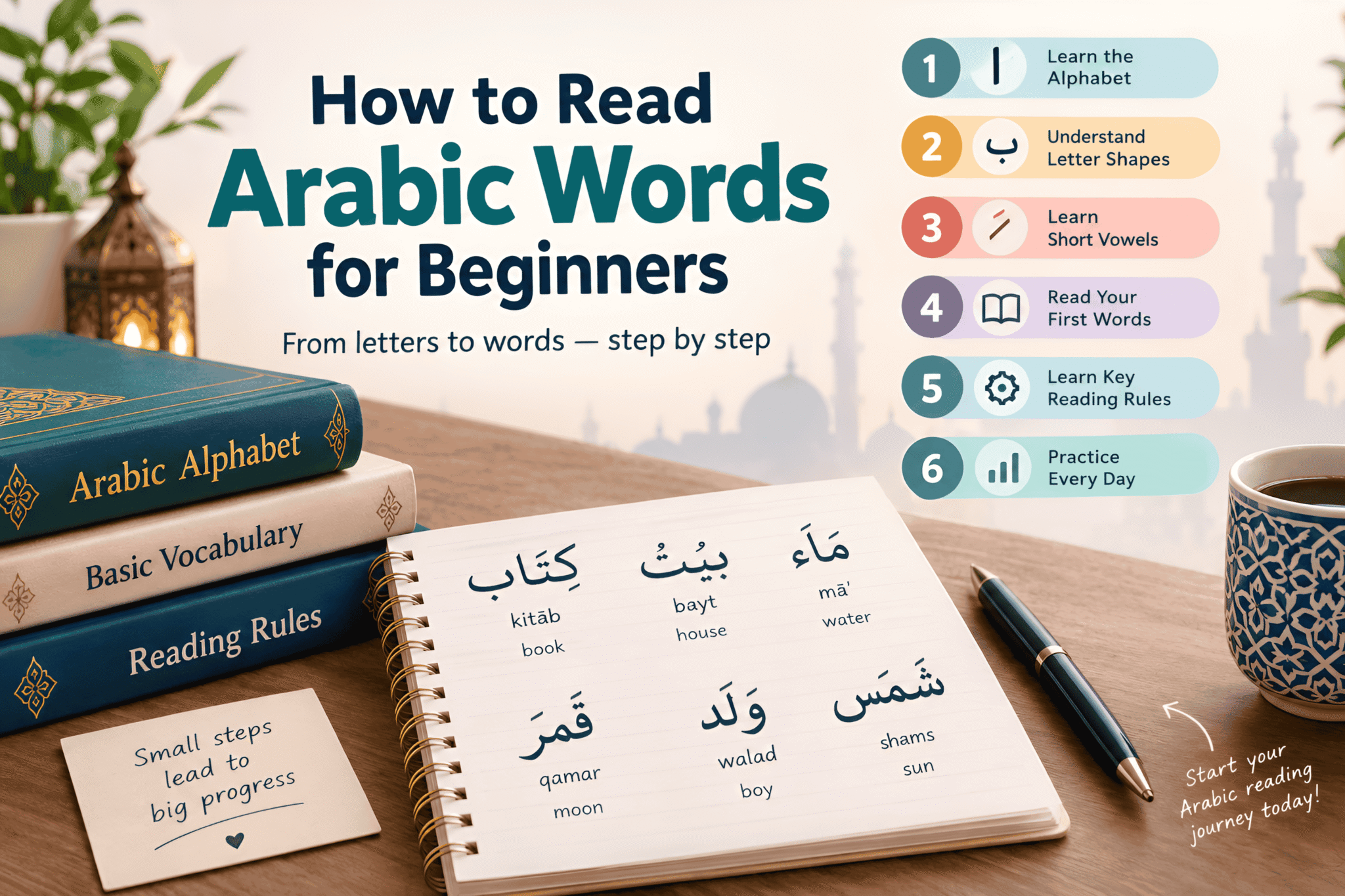
Learning how to read Arabic words for beginners may seem challenging at first, especially if you are used to reading English from left to right. Arabic has a different writing direction, letters that change shape depending on their position, and vowel marks that help you pronounce words correctly.
The good news is that you do not need to understand every Arabic grammar rule before you start reading. By learning the letters, recognizing how they connect, understanding short vowels, and practising simple words, you can gradually build your Arabic reading skills.
In this guide, you will learn how to read Arabic words step by step, practise with beginner-friendly examples, avoid common mistakes, and follow a practical four-week study plan.
How Does Arabic Reading Work?
Before you begin reading Arabic words, it helps to understand three basic features of the Arabic writing system.
- Arabic is written from right to left.
Unlike English, Arabic words and sentences are read from right to left. For example, the Arabic word for “book” is:
كِتَاب – kitāb – book
Start at the right side of the word and move toward the left.
- Arabic letters often connect to each other.
Most Arabic letters join together when they appear inside a word. This means a letter may look different depending on whether it appears at the beginning, middle, or end of a word.
- Short vowels are often written as marks.
Arabic uses small marks above or below letters to show short vowel sounds. These marks are especially helpful when you are learning to read Arabic for the first time.
You can learn more about the writing system in this Arabic alphabet guide with pronunciation and audio.
Step 1: Learn to Recognize Arabic Letters
The first step in learning to read Arabic words is recognizing the letters and connecting each letter with its sound.
The Arabic alphabet has 28 basic letters. Some sounds are familiar to English speakers, while others require extra practice.
Here are a few letters to start with:
| Arabic Letter | Name | Approximate Sound |
| ا | Alif | Often associated with a long “aa” sound, depending on context |
| ب | Baa | b, as in “book” |
| ت | Taa | t, as in “table” |
| م | Meem | m, as in “moon” |
| ن | Noon | n, as in “name” |
| س | Seen | s, as in “sun” |
| ل | Laam | l, as in “light” |
These English comparisons are only approximations. Some Arabic sounds do not have exact equivalents in English, so listen to native pronunciation when possible.
Practise Recognizing Letters
Look at these letters and say their sounds aloud:
- ب – Baa
- م – Meem
- س – Seen
- ل – Laam
- ن – Noon
Next, try recognizing them inside words. You do not have to memorize every letter in one sitting. Learn a small group, review it, and then move on to the next group.
For a complete letter-by-letter explanation, visit the Arabic alphabet guide.
Step 2: Understand Arabic Letter Shapes in Words
Recognizing a letter in isolation is only the beginning. You also need to recognize its shape when it connects to other letters.
Many Arabic letters have up to four contextual forms:
- Isolated: The letter appears by itself.
- Initial: The letter appears at the beginning of a connected word.
- Medial: The letter appears in the middle of a connected word.
- Final: The letter appears at the end of a connected word.
For example, the letter Baa can appear in these forms:
| Position | Form |
| Isolated | ب |
| Initial | بـ |
| Medial | ـبـ |
| Final | ـب |
The basic letter remains Baa, even though its appearance changes.
Learn Which Arabic Letters Do Not Connect to the Following Letter
Six important Arabic letters do not connect to the letter immediately following them in the normal direction of Arabic writing:
ا، د، ذ، ر، ز، و
This does not mean they cannot connect to a preceding letter. It means they do not join to the next letter on their left.
For example, the word بَاب (bāb, “door”) contains Alif between two Baa letters. The Alif interrupts the connection, so the word does not form one continuous joined shape.
Understanding this rule makes unfamiliar Arabic words much easier to decode.
Practice tip: Choose a short word and identify each letter separately before reading the complete word. Then look at how the letters connect and notice where a connection stops.
Want to Learn Arabic with Guided Lessons?
Take your Arabic reading skills further with our step-by-step Arabic Reading Course, designed to guide you through the learning process.
Step 3: Learn Arabic Short Vowels
Arabic short vowels are essential for beginners because they help you identify how a letter should be pronounced.
The three main short vowel marks are:
| Mark | Arabic Name | Example | Approximate Sound |
| َ | Fatha | بَ | ba |
| ِ | Kasra | بِ | bi |
| ُ | Damma | بُ | bu |
Notice that the letter remains the same while the vowel mark changes the sound.
- بَ sounds like ba.
- بِ sounds like bi.
- بُ sounds like bu.
These examples use short vowel sounds. They are different from long vowels, which take more time to pronounce.
Why Are Short Vowels Important?
Consider these examples:
- كَتَبَ – kataba – he wrote.
- كُتُب – kutub – books.
The same consonant letters can appear with different vowel patterns, producing different pronunciations and meanings.
In many everyday Arabic texts, short vowel marks are omitted. Beginners’ materials often include them because they make pronunciation easier to learn.
Start by practising words with vowel marks. Once you become more confident, gradually introduce words without them.
Step 4: Read Your First Arabic Words
Now that you understand letters, connections, and short vowels, you can start combining these skills.
Begin with short, familiar words. Read each word from right to left, identify the letters, notice the vowel marks, and then pronounce the word.
| Arabic Word | Pronunciation | English Meaning |
| بَاب | bāb | Door |
| بَيْت | bayt | House |
| قَمَر | qamar | Moon |
| وَلَد | walad | Boy |
| كِتَاب | kitāb | Book |
| قَلَم | qalam | Pen |
The pronunciation guides are approximate. In particular, the vowel in a transliteration such as qamar may not capture every detail of Arabic pronunciation.
How to Decode an Arabic Word
Let’s practise with قَمَر (qamar), meaning “moon.”
- Start on the right. The first letter is ق (Qaaf).
- Identify the next letter. The middle letter is م (Meem).
- Identify the final letter. The last letter is ر (Raa).
- Read the vowel marks. The Fatha above Qaaf gives a short qa sound, and the Fatha above Meem gives a short ma sound.
- Blend the sounds. Read the letters together as qa-mar.
You have now decoded a complete Arabic word instead of memorizing its shape as a picture.
Try Reading These Words
Read each word aloud before checking the pronunciation and meaning.
| Arabic | Pronunciation | Meaning |
| مَاء | māʾ | Water |
| سَمَك | samak | Fish |
| جَبَل | jabal | Mountain |
| كَلْب | kalb | Dog |
Notice that some words contain a long vowel, while others include a Sukoon mark or no written short vowels. These features affect how the words are read.
If you want to expand your vocabulary alongside your reading skills, explore this guide to basic Arabic words for beginners.
Step 5: Practise Longer Words and Essential Reading Rules
Once you can read simple words, begin learning the rules that help you handle more complex Arabic writing.
You do not need to master every rule immediately. Learn one concept, practise it in several words, and then move to the next.
Long Vowels (Madd Letters)
Arabic commonly uses three letters to represent long vowel sounds:
- ا – Alif: Often represents a long ā sound.
- و – Waaw: Can represent a long ū sound.
- ي – Yaa: Can represent a long ī sound.
For example:
- بَاب – bāb – door.
- نُور – nūr – light.
- فِيل – fīl – elephant.
The exact sound depends on the letters and vowel marks in the word. Waaw and Yaa can also function as consonants, so learn to recognize them from context.
Sukoon
Sukoon is written as ْ and indicates that a consonant has no short vowel immediately after it.
For example:
كَلْب – kalb – dog
The Sukoon above Laam tells you not to add a short vowel after that consonant. Read the sounds together rather than saying ka-la-ba.
Shadda
Shadda is written as ّ and indicates that a consonant is doubled or held for an additional consonant timing.
For example:
مُدَرِّس – mudarris – teacher
The Shadda on Raa indicates that the Raa sound is doubled. Do not ignore the mark when reading the word aloud.
Tanween
Tanween consists of vowel marks that commonly indicate an n sound at the end of certain nouns when pronounced in connected reading.
The three marks are:
- ً – Fathatan
- ٍ – Kasratan
- ٌ – Dammatan
For example, كِتَابٌ is often transliterated kitābun in a fully vowelled grammatical context.
The exact pronunciation of Tanween depends on the word and whether you continue reading or stop. Learn the basic pattern first, then study its application in sentences.
Alif Lam: Shamsiya and Qamariya
The definite article ال usually corresponds to “the.”
In words with a sun letter, the L sound is assimilated into the following consonant in pronunciation. With a moon letter, the L sound is pronounced.
Examples:
- الشَّمْس – ash-shams – the sun.
- الْقَمَر – al-qamar – the moon.
This is why the written form and the spoken pronunciation do not always match letter by letter.
Hamza
Hamza represents a glottal stop and can appear in different written forms, including ء، أ، إ، ؤ، ئ.
Beginners should first learn to recognize it. More advanced practice can cover the differences between Hamza Wasl and Hamza Qat and how they are pronounced in connected speech.
These reading rules become easier when taught in a sensible order and practised in real words rather than memorized as a long list.
Step 6: Practise Reading Arabic Every Day
Consistent practice is more useful than trying to memorize everything in one session.
If you are learning how to read Arabic words for beginners, try this simple daily routine.
A 15-minute practice session
- 3 minutes: Review letters and their sounds.
- 4 minutes: Read connected letters and short vowel combinations.
- 5 minutes: Practise five to ten Arabic words.
- 3 minutes: Read the words aloud again and correct mistakes.
As you improve, replace some individual words with short phrases or sentences.
Use a Simple Reading Checklist
Before finishing each session, ask yourself:
- Can I recognize the letters in the word?
- Did I read from right to left?
- Did I notice where letters connect or stop connecting?
- Did I pronounce the vowel marks correctly?
- Can I read the word again without looking at the transliteration?
If you cannot answer yes to every question, return to the relevant example and practise it again. Repetition is a normal part of learning to read a new writing system.
A 4-Week Arabic Reading Study Plan
A structured plan can help you progress from recognizing individual letters to reading complete words. The following schedule follows the four-week sequence used in our Arabic reading course. Treat it as a suggested pace rather than a guarantee of mastery within a fixed period.
| Week | What You Will Learn | Practical Exercises |
| Week 1: Arabic Alphabet | Learn the letters, sounds, and pronunciation. | Recognize and pronounce each letter. Read simple words using the letters you have learned. |
| Week 2: Letter Shapes and Short Vowels | Learn how letters change shape at the beginning, middle, and end of words. Study short vowels and letter connections. | Identify letters in different positions, recognize vowel marks, and read connected letters and simple words. |
| Week 3: Essential Arabic Reading Rules | Study Tanween, Sukoon, Shadda, Alif Lam Shamsiya and Qamariya, Madd letters, Hamza Wasl, and Hamza Qat. | Identify the signs in Arabic words and practise reading words that use these rules. |
| Week 4: Reading Practice | Review Hamza forms and reading rules. Explore differences between standard Arabic writing and Quranic writing. | Combine the skills you have learned, practise words, review challenging examples, and work on reading accuracy. |
Tips for Following the Plan
- Complete one lesson at a time instead of rushing through the material.
- Review the accompanying PDF materials to reinforce what you learn.
- Read aloud whenever possible so you practise pronunciation as well as recognition.
- Repeat lessons when a rule or letter shape is still confusing.
- Keep a list of words that you find difficult and revisit them regularly.
Your progress will depend on your starting point, practice time, and how consistently you review. The purpose of the four-week plan is to provide a clear path, not to impose a deadline.
Common Arabic Reading Mistakes Beginners Should Avoid
Learning the right habits early can save you time and frustration.
1. Trying to Read Without Learning Letter Shapes
Memorizing isolated letters is not enough. You must also recognize their connected forms.
What to do: Practise the same letter in different positions and compare it with complete words.
2. Ignoring Short Vowel Marks
A vowel mark can change a word’s pronunciation and sometimes its meaning.
What to do: Start with fully vowelled beginner examples and read the marks aloud. Gradually practise less-vowelled text as your skills improve.
3. Adding Extra Vowels Between Consonants
Beginners sometimes insert extra vowel sounds because connected consonants feel unfamiliar.
What to do: Pay attention to Sukoon and practise blending sounds without adding a vowel that is not written or pronounced.
4. Confusing Similar-Looking Letters
Some Arabic letters share a basic shape and differ mainly in their dots. For example, ب، ت، ث have a similar base shape but different dot patterns.
What to do: Look carefully at the dots before identifying the letter. Review similar-looking letters together.
5. Depending Only on English Transliteration
Transliteration can help you get started, but it does not always represent Arabic sounds accurately. If you rely on it for too long, you may find it harder to recognize Arabic script independently.
What to do: Use transliteration as temporary support. Always look at the Arabic word and try to read it before checking the English pronunciation guide.
6. Moving to Difficult Texts Too Quickly
Long passages can overwhelm beginners who are still learning letter connections and vowel marks.
What to do: Start with short, simple words, then move to phrases and sentences as your accuracy improves.
Frequently Asked Questions
1. How can a beginner start reading Arabic words?
Start by learning the Arabic letters and their sounds. Next, practise connected letter shapes and short vowel marks. Then read short, fully vowelled words and gradually move to longer words and simple sentences.
2. Is Arabic difficult to read for English speakers?
Arabic may feel unfamiliar at first because it is written from right to left and its letters change shape depending on their position. However, learning the writing system in small steps and practising regularly can make the process more manageable.
3. How long does it take to learn to read Arabic?
The time varies depending on your starting point, practice frequency, and the level of reading you want to achieve. A consistent four-week study plan can help you build a foundation, but reading confidently takes continued practice.
4. Do I need to learn Arabic grammar before reading words?
No. You can begin recognizing letters, vowel marks, and simple words before studying Arabic grammar in depth. Basic reading rules will help you pronounce words more accurately as you progress.
5. What are Arabic short vowels?
The three main short vowel marks are Fatha (َ), Kasra (ِ), and Damma (ُ). They indicate short vowel sounds and appear above or below letters. They are particularly useful in beginner learning materials.
6. Can I learn to read Arabic on my own?
Yes, many beginners use self-study materials, pronunciation recordings, and regular practice. A structured course can also help you follow a logical sequence, understand confusing rules, and practise with guided examples.
7. Should beginners learn Arabic letters or words first?
Learn the letters and their sounds first, but start reading simple words as soon as you can recognize a few letters. Combining letter practice with real words helps you understand how Arabic writing works.
Start Learning to Read Arabic Step by Step
You do not need to master the entire Arabic language before you begin reading. Focus on recognizing letters, understanding their connected forms, learning short vowels, and practising simple words every day.
As you become more comfortable, you can move on to longer words, essential reading rules, and short sentences. A clear learning sequence can help you build your skills without feeling overwhelmed.
If you would like structured lessons instead of figuring out every step on your own, explore the Arabic Reading Course for Beginners. It is designed for complete beginners and covers letter recognition, connected forms, pronunciation, and practical reading exercises.
Ready to begin? Visit the course page and try the first lesson free to see how the lessons work.
Your next step is simple: learn a few letters, practise a few words, and keep building from there.
Additional Resource
For a general reference about the Arabic writing system, see the Arabic alphabet article on Wikipedia.