

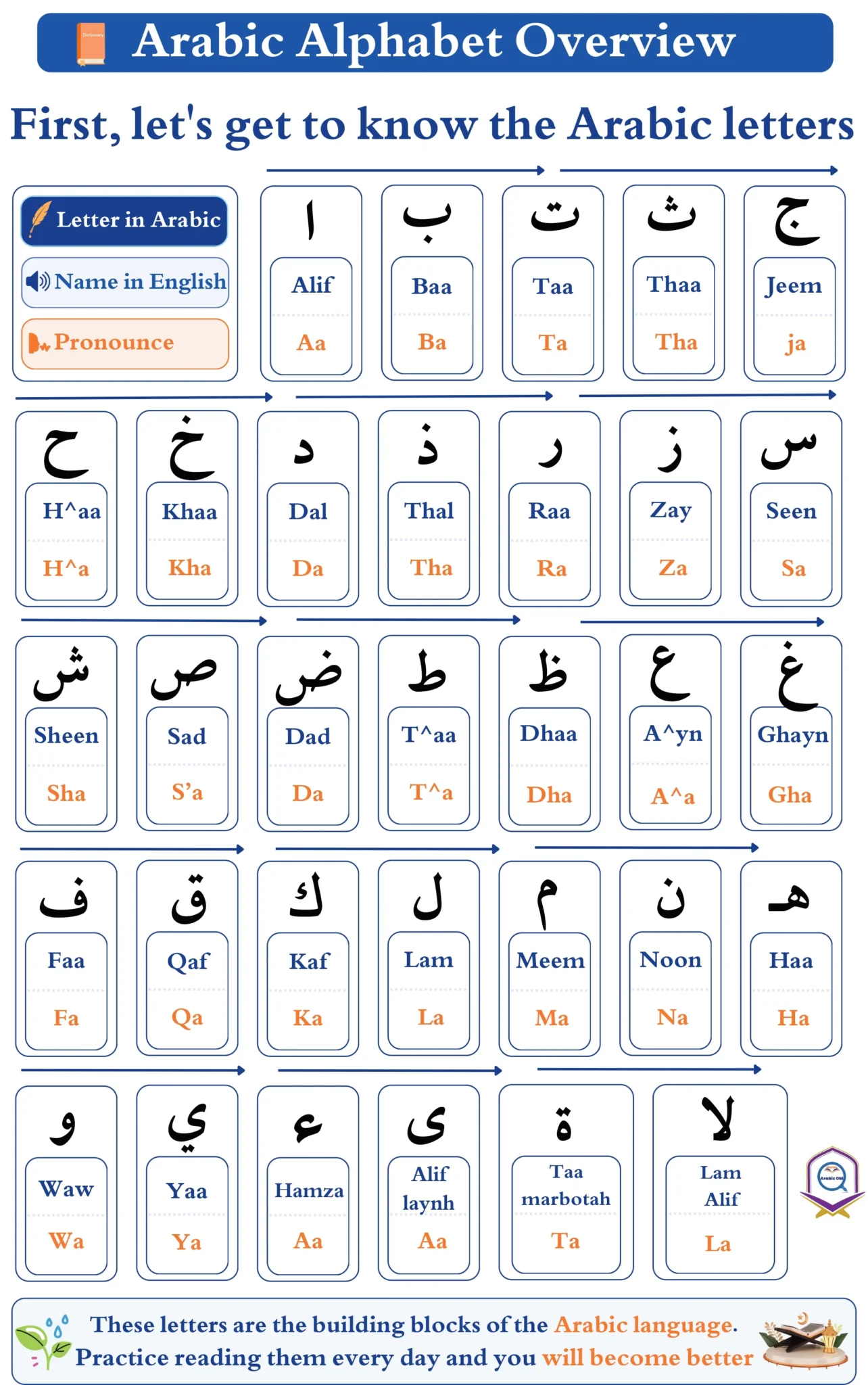
Alphabet in Arabic is the first thing every beginner should learn before reading Arabic words or the Holy Quran. Whether you are learning Arabic for travel, conversation, or Quran recitation, mastering the Arabic alphabet is the foundation of your journey. If you are searching for Arabic to Alphabet resources or an easy alphabet Arabic guide, this lesson will help you recognize, pronounce, and read the 28 Arabic letters step by step.
In this complete guide, you will learn all 28 Arabic letters, hear the pronunciation of every letter through audio, discover practical examples, understand common pronunciation mistakes, and build the confidence to start reading Arabic correctly.
What Is the Arabic Alphabet? A Beginner’s Guide
The Arabic alphabet is the writing system used to write Arabic. For beginners searching for an alphabet Arabic guide, understanding the 28 letters, their sounds, and how they connect is the first step toward reading Arabic.
The Arabic alphabet contains 28 primary letters, each with a unique sound. Some sounds are familiar to English speakers, while others require practice because they are produced from different parts of the mouth or throat.
Unlike the English alphabet, Arabic letters connect together to form words, creating the elegant script seen in books, signs, and the Holy Quran.
For millions of Muslims around the world, learning the alphabet in Arabic is the first step toward reading the Quran correctly.
The 28 Arabic Letters and Other Important Forms
The Arabic alphabet traditionally consists of 28 primary letters. In addition to these 28 letters, beginners will also encounter other important Arabic writing forms, such as Hamza (ء), Alif Maqsurah (ى), Taa Marbutah (ة), and Lam Alif (لا).
These forms are included in this guide because beginners need to recognize them when reading Arabic, but they should not be counted as additional letters of the traditional 28-letter Arabic alphabet.
- Hamza (ء): represents a distinct glottal stop and can appear in several written forms.
- Alif Maqsurah (ى): a final form used in certain words and pronounced as a long aa sound.
- Taa Marbutah (ة): a special final form commonly found in feminine nouns.
- Lam Alif (لا): a combination of Laam (ل) and Alif (ا), not a separate letter.
How Many Letters Are in the Arabic Alphabet?
The Arabic alphabet has:
- 28 basic letters
- Written from right to left
- No capital letters
- Letters change shape depending on their position
- Three long vowel letters
- Several unique sounds not found in English
Once you know these 28 letters, you can begin reading almost any Arabic word.
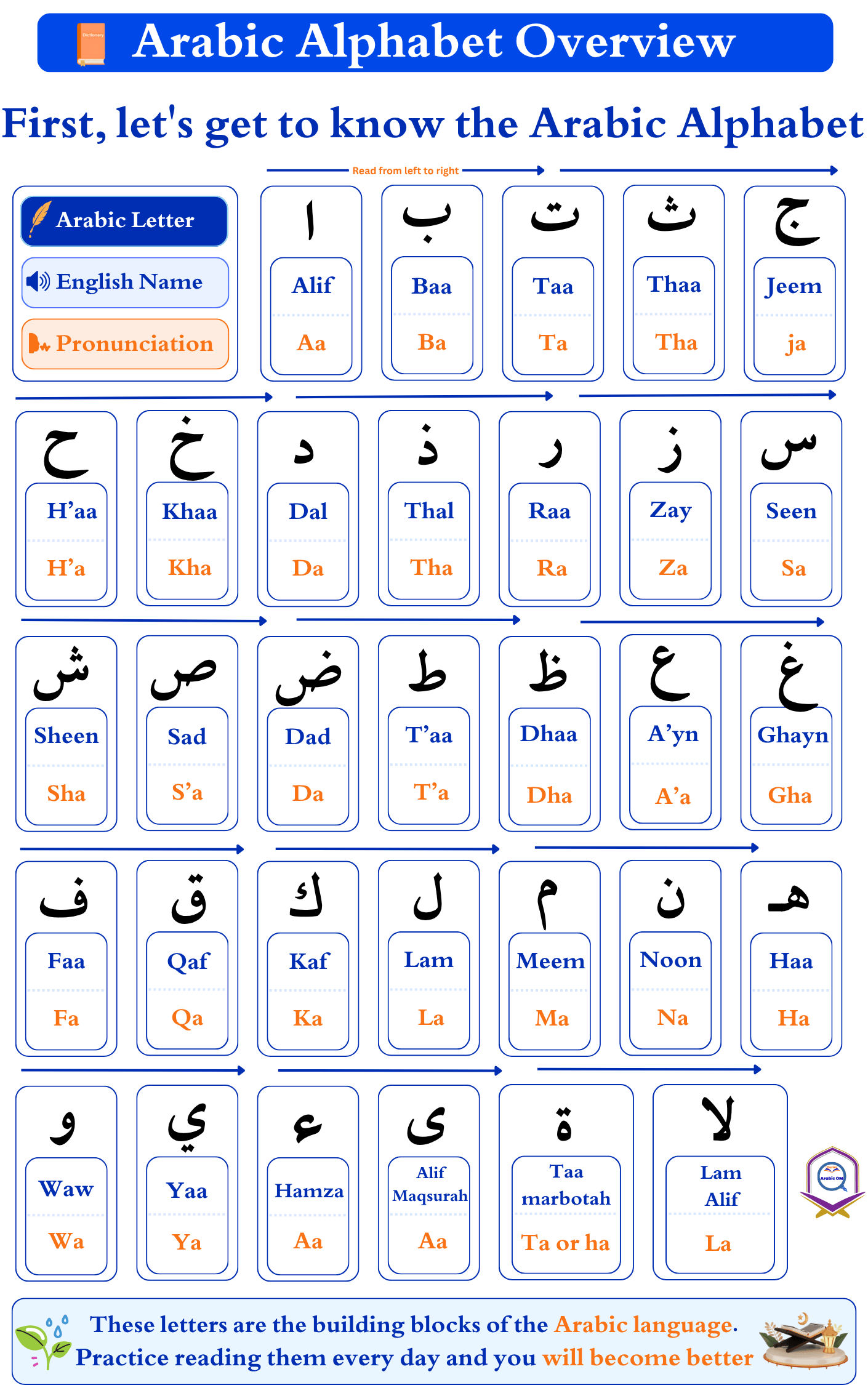
Arabic Alphabet Chart
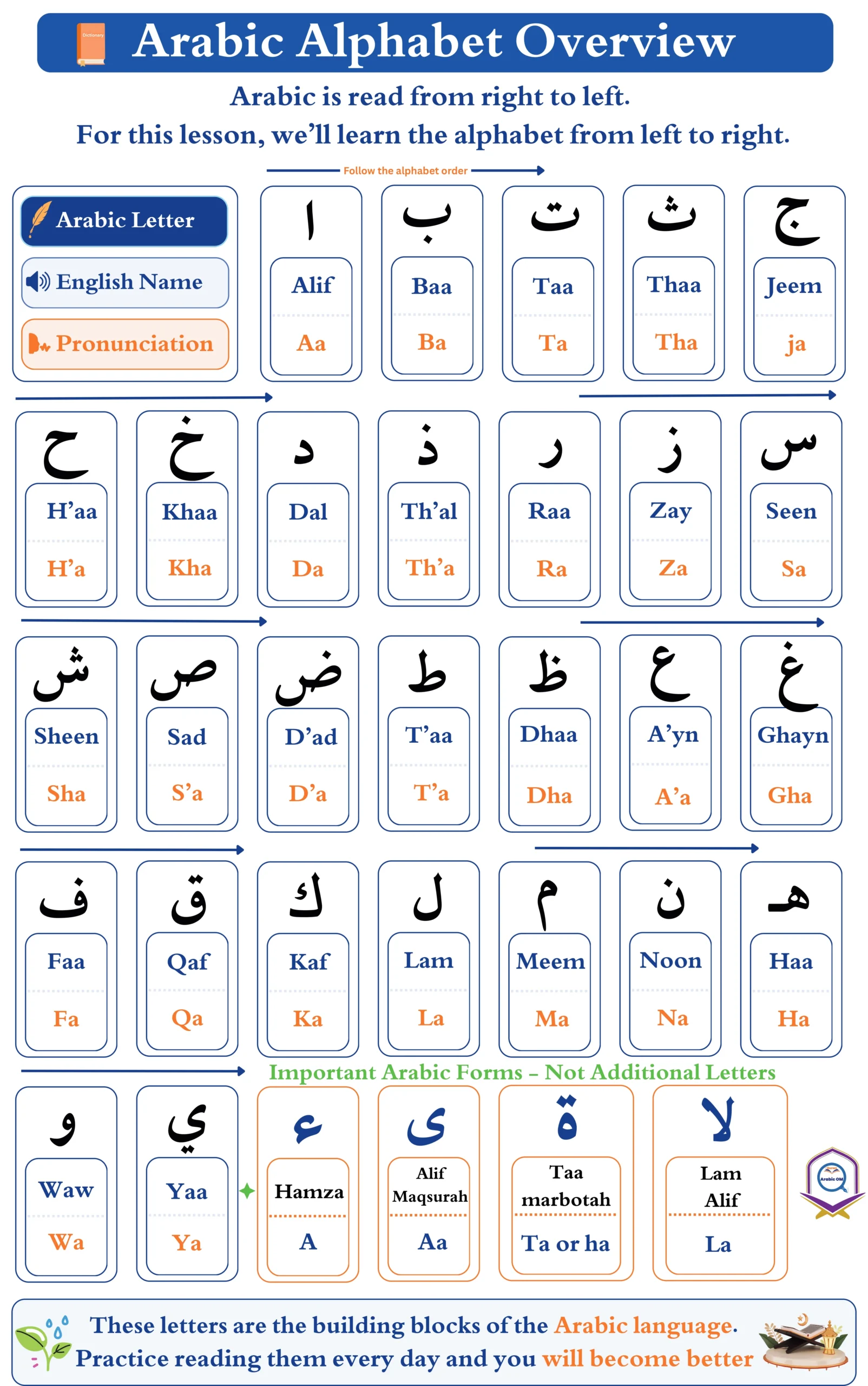
Jump to any Arabic letter:
Alif |
Baa |
Taa |
Thaa |
Jeem |
H’aa |
Khaa |
Daal |
Thaal |
Raa |
Zay |
Seen |
Sheen |
Saad |
Daad |
T’aa |
Dhaa |
A’in |
Ghayn |
Faa |
Qaaf |
Kaaf |
Laam |
Meem |
Noon |
Haa |
Waw |
Yaa |
Hamza |
Alif Maqsurah |
Taa Marbutah |
Lam Alif |
Click any pronunciation button below to hear the correct sound of every Arabic letter. Practice listening and repeating each sound until you feel comfortable before moving to the next letter.
Alif (ا) | Alphabet in Arabic
Arabic Letter
ا
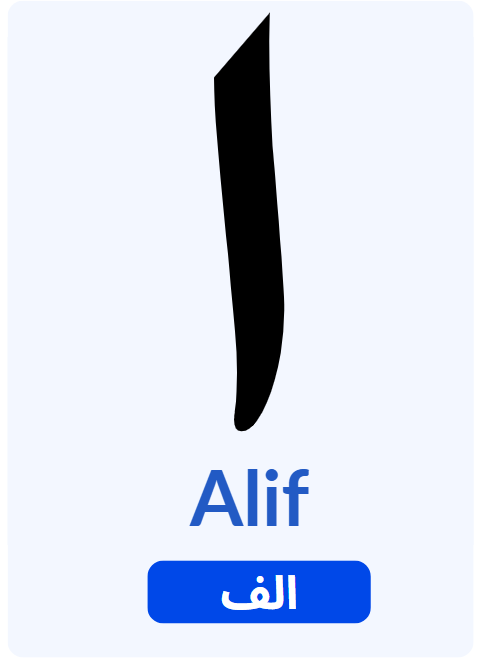
Letter Name
Alif
Pronunciation
Aa
Listen to the pronunciation
Master this letter before moving to the next one. Click the audio button, repeat the sound at least five times, then read the example words aloud.
How to Pronounce Alif
Alif is one of the easiest letters in the alphabet in Arabic. It produces a long “aa” sound, similar to the a in the English word father.
Unlike many other Arabic letters, Alif is produced without friction or throat pressure, making it an excellent starting point for beginners.
Example Words
- أسد (Lion)
- أحمد (Ahmad)
- الله (Allah)
Common Mistakes
Many beginners pronounce Alif like the English letter A in apple.
Instead, keep the sound longer and softer.
Baa (ب) | Alphabet in Arabic
Arabic Letter
ب
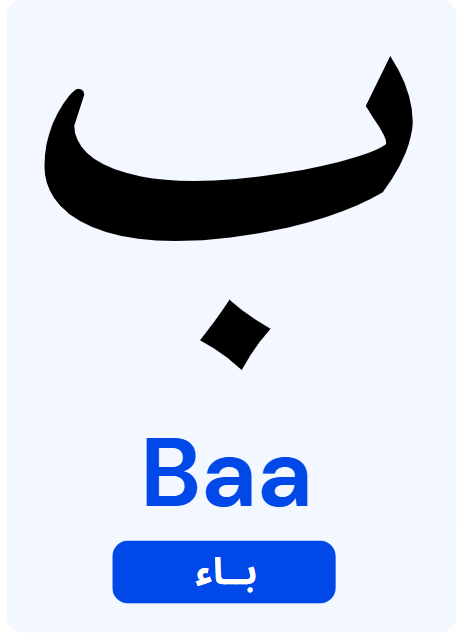
Letter Name
Baa
Pronunciation
Ba
Listen to the pronunciation
How to Pronounce Baa
Baa is the second letter in the alphabet in Arabic. It makes the “b” sound, just like the B in the English words book, ball, and baby.
To pronounce Baa correctly, gently close both lips together, then release the sound smoothly while saying Ba.
For most English speakers, Baa is one of the easiest Arabic letters to pronounce because it is almost identical to the English letter B.
Example Words
باب (Door)
بيت (House)
بطة (Duck)
Common Mistakes
Some beginners accidentally pronounce Baa like the English letter P.
Remember that Arabic does not have the P sound. Always pronounce this letter with a clear B sound by bringing your lips together before releasing the air.
Tip for Beginners
Practice saying Ba several times before reading the example words. Once you can pronounce the letter comfortably, listen to the audio again and repeat each word slowly.
Taa (ت) | Alphabet in Arabic
Arabic Letter
ت
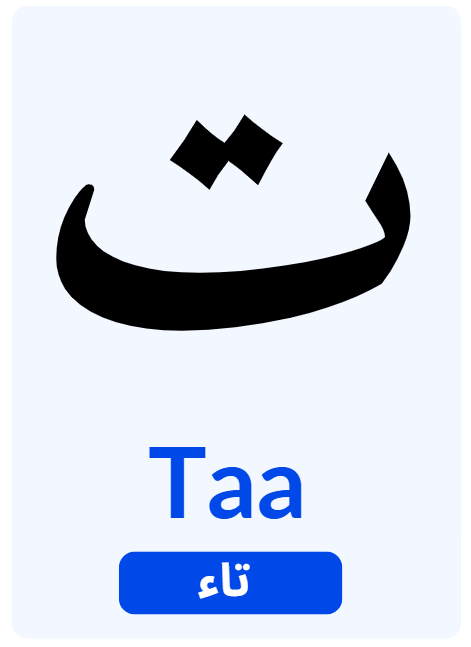
Letter Name
Taa
Pronunciation
Ta
Listen to the pronunciation
How to Pronounce Taa
Taa is the third letter in the alphabet in Arabic. It produces a clear “t” sound, similar to the T in the English words table, teacher, and time.
To pronounce Taa correctly, place the tip of your tongue gently behind your upper front teeth, then release the air with a light “t” sound.
For English speakers, Taa is one of the easiest letters in the alphabet in Arabic because its pronunciation is almost identical to the English letter T.
Example Words
تمر (Dates)
تفاح (Apple)
تاج (Crown)
Common Mistakes
Some beginners pronounce Taa too softly, making it sound unclear.
Remember that Taa should always have a clean and crisp T sound. It should never sound heavy like the Arabic letter Taa (ط), which you will learn later in this guide.
Practice slowly, listen to the audio, and repeat until the pronunciation feels natural.
Thaa (ث) | Alphabet in Arabic
Arabic Letter
ث
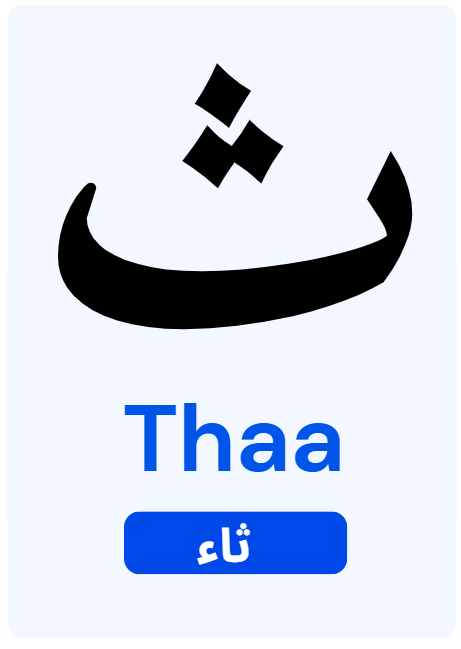
Letter Name
Thaa
Pronunciation
Tha
Listen to the pronunciation
How to Pronounce Thaa
Thaa is the fourth letter in the alphabet in Arabic. It produces the “th” sound, similar to the TH in the English words think, three, and thumb.
To pronounce Thaa correctly, gently place the tip of your tongue between your upper and lower front teeth, then let the air flow smoothly while saying Tha.
Although this sound is common in English, some beginners still need a little practice to pronounce it naturally when reading Arabic words.
Example Words
ثعلب (Fox)
ثوب (Dress)
ثلاثة (Three)
Common Mistakes
Some beginners pronounce Thaa like the English S sound or the Arabic letter Seen (س).
Others pronounce it like the letter Taa (ت).
Remember that Thaa should always sound like the TH in the English word think. Keep the tip of your tongue gently between your teeth while allowing the air to pass naturally.
Practice slowly, listen to the audio several times, and repeat each example word until you feel comfortable with the pronunciation.
Jeem (ج) | Alphabet in Arabic
Arabic Letter
ج
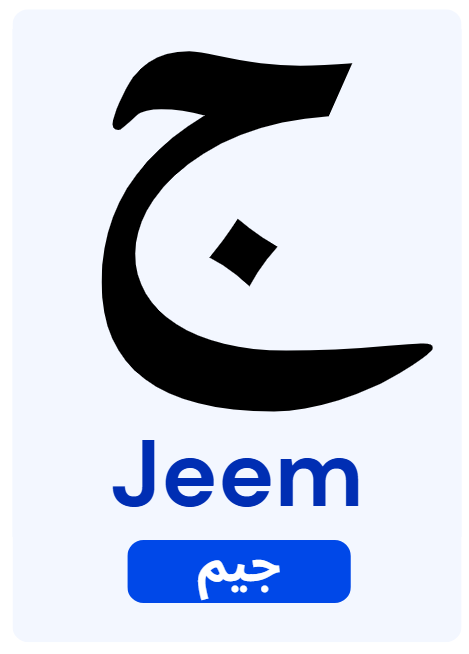
Letter Name
Jeem
Pronunciation
J
Listen to the pronunciation
How to Pronounce Jeem
Jeem is the fifth letter in the alphabet in Arabic. It usually produces the “j” sound, similar to the J in the English words jump, juice, and job.
To pronounce Jeem correctly, gently press the middle of your tongue toward the roof of your mouth and release the sound smoothly while saying Ja.
In Modern Standard Arabic, Jeem is pronounced with a clear J sound. However, you may hear different pronunciations in some Arabic dialects. Since this guide teaches Modern Standard Arabic for reading and understanding the Quran, always learn the standard pronunciation first.
Example Words
جمل (Camel)
جنة (Paradise)
جميل (Beautiful)
Common Mistakes
Some beginners pronounce Jeem like the English G in go or like the French J in bonjour.
Remember that the standard Arabic Jeem has a clear J sound, similar to the English word jump.
Listen to the audio several times and repeat the example words until you can pronounce the letter confidently.
Haa (ح) | Alphabet in Arabic
Arabic Letter
ح
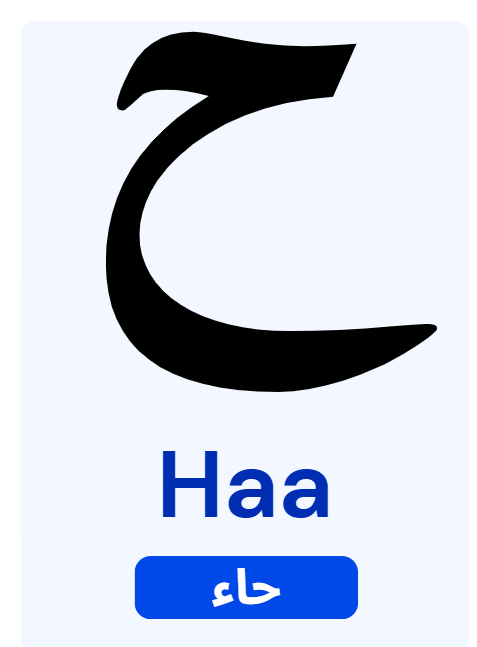
Letter Name
Haa
Pronunciation
Ha
Listen to the pronunciation
How to Pronounce Haa
Haa is the sixth letter in the alphabet in Arabic. It produces a soft “h” sound that comes from the middle of the throat. Unlike the English letter H, the Arabic Haa is deeper and slightly stronger, but it should never sound harsh.
To pronounce Haa correctly, gently allow the air to flow from the middle of your throat while keeping your mouth relaxed. Avoid using your lips or tongue to produce the sound.
For many English speakers, Haa is one of the first throat letters they learn in the alphabet in Arabic. It may take some practice, but with regular listening and repetition, it becomes much easier.
Example Words
حمد (Praise)
حليب (Milk)
حصان (Horse)
Common Mistakes
Many beginners pronounce Haa exactly like the English letter H.
Although they sound similar, the Arabic Haa comes from deeper inside the throat. It should sound soft and clear without becoming rough or heavy.
Listen carefully to the audio and repeat the sound several times before reading the example words aloud.
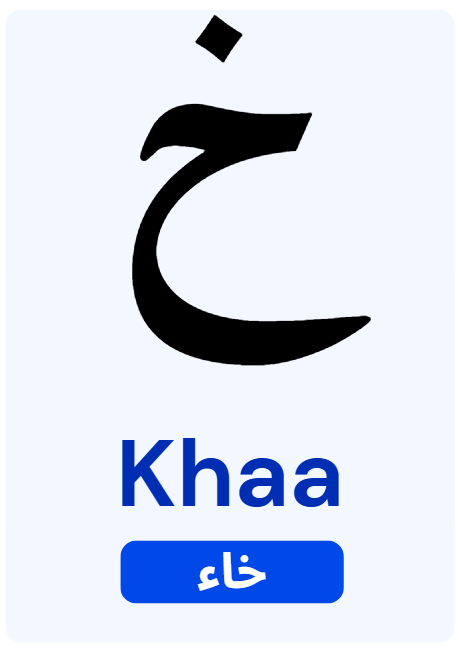
Khaa (خ) | Alphabet in Arabic
Arabic Letter
خ
Letter Name
Khaa
Pronunciation
Kh
Listen to the pronunciation
How to Pronounce Khaa
Khaa is the seventh letter in the alphabet in Arabic. It produces a deep “kh” sound that comes from the upper part of the throat. This sound does not exist in standard English, so it may feel unfamiliar at first.
To pronounce Khaa correctly, allow the air to pass gently through the back of your throat while keeping your mouth relaxed. The sound should be smooth and continuous, not forced or overly harsh.
Many beginners need a little extra practice with Khaa because it is one of the unique sounds in the alphabet in Arabic. Listening to the audio and repeating the sound several times will help you master its pronunciation.
Example Words
خبز (Bread)
خروف (Sheep)
خالد (Khalid)
Common Mistakes
Many beginners pronounce Khaa like the English K sound or the Arabic letter Haa (ح).
Remember that Khaa comes from higher in the throat than Haa and has a gentle friction as the air passes through. It should sound clear and natural without becoming too strong.
Listen carefully to the audio and repeat the example words until you can hear and produce the difference between Haa (ح) and Khaa (خ) confidently.
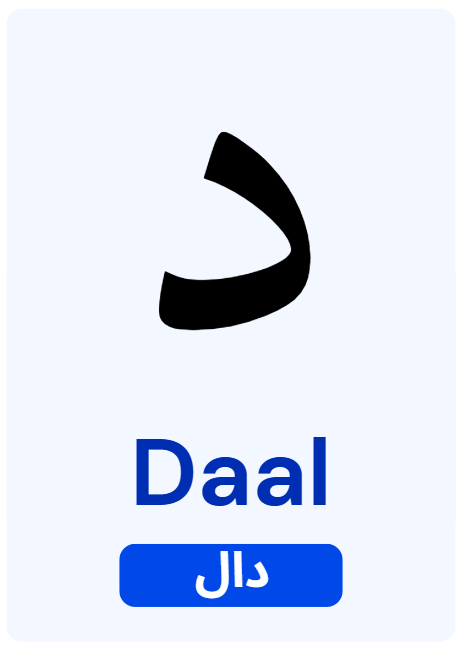
Daal (د) | Alphabet in Arabic
Arabic Letter
د
Letter Name
Daal
Pronunciation
Da
Listen to the pronunciation
How to Pronounce Daal
Daal is the eighth letter in the alphabet in Arabic. It produces a clear “d” sound, similar to the D in the English words dog, door, and day.
To pronounce Daal correctly, gently place the tip of your tongue against the back of your upper front teeth, then release the sound smoothly while saying Da.
For English speakers, Daal is one of the easiest letters in the alphabet in Arabic because its pronunciation is very close to the English letter D.
Example Words
درس (Lesson)
دجاج (Chicken)
دواء (Medicine)
Common Mistakes
Most beginners pronounce Daal correctly from the beginning. However, some learners make the sound too heavy, causing it to resemble the Arabic letter Daad (ض), which you will learn later.
Remember that Daal should always sound light, clear, and natural, just like the D in the English word door.
Listen to the audio several times and repeat the example words until the pronunciation feels comfortable and consistent.
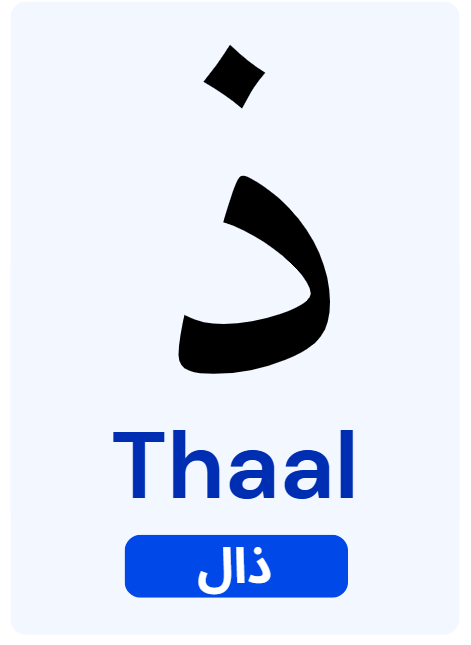
Thaal (ذ) | Alphabet in Arabic
Arabic Letter
ذ
Letter Name
Dhaal
Pronunciation
Dh
Listen to the pronunciation
How to Pronounce Dhaal
Dhaal is the ninth letter in the alphabet in Arabic. It produces the “th” sound found in the English words this, that, and these.
To pronounce Dhaal correctly, gently place the tip of your tongue between your upper and lower front teeth, then allow your voice to flow while saying Dha.
Unlike Thaa (ث), which has a soft, unvoiced TH sound like think, Dhaal (ذ) has a voiced TH sound like this. This small difference is very important when learning the alphabet in Arabic.
Example Words
ذهب (Gold)
ذكي (Smart)
ذراع (Arm)
Common Mistakes
Many beginners pronounce Dhaal like the English Z sound or like the Arabic letter Daal (د).
Remember that Dhaal should sound like the TH in the English word this. Keep the tip of your tongue gently between your teeth while using your voice to produce the sound.
Listen carefully to the audio and practice the example words until you can clearly hear the difference between Daal (د) and Dhaal (ذ).
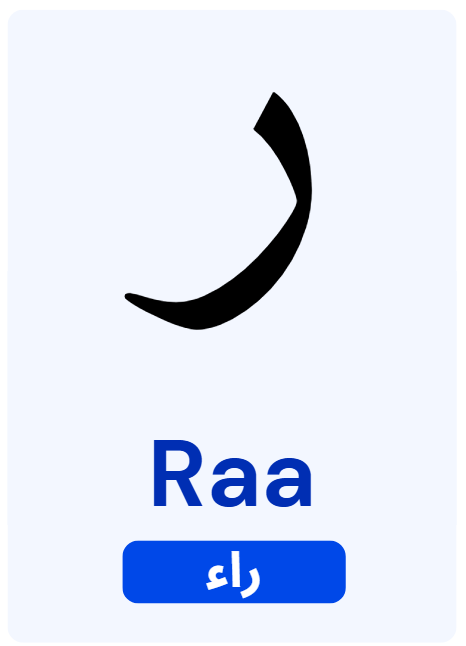
Raa (ر) | Alphabet in Arabic
Arabic Letter
ر
Letter Name
Raa
Pronunciation
Ra
Listen to the pronunciation
How to Pronounce Raa
Raa is the tenth letter in the alphabet in Arabic. It produces a rolled or lightly tapped “r” sound, similar to the R in the Spanish word pero or the Italian word Roma.
To pronounce Raa correctly, gently tap the tip of your tongue against the roof of your mouth just behind your upper front teeth. The movement should be quick and light.
For many English speakers, this is one of the first letters that feels different because the English R is produced differently. With regular listening and practice, you will quickly become comfortable with the Arabic Raa.
Example Words
رجل (Man)
رسول (Messenger)
رمضان (Ramadan)
Common Mistakes
Many beginners pronounce Raa like the English R, which is produced farther back in the mouth.
Remember that the Arabic Raa should be made by lightly tapping the tip of your tongue behind your upper front teeth. The sound should be clear and light, not stretched or heavy.
Listen carefully to the audio and repeat the example words until you can pronounce Raa naturally and confidently.
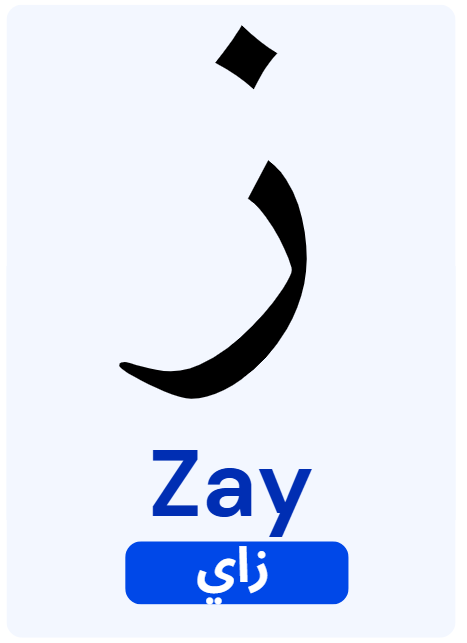
Zay (ز) | Alphabet in Arabic
Arabic Letter
ز
Letter Name
Zay
Pronunciation
Za
Listen to the pronunciation
How to Pronounce Zay
Zay is the eleventh letter in the alphabet in Arabic. It produces the “z” sound, similar to the Z in the English words zebra, zoo, and zero.
To pronounce Zay correctly, place the tip of your tongue close to the back of your upper front teeth without touching them firmly. Then allow your voice to flow while saying Za.
For English speakers, Zay is one of the easiest letters in the alphabet in Arabic because its pronunciation is almost identical to the English letter Z.
Example Words
زهرة (Flower)
زيت (Oil)
زرافة (Giraffe)
Common Mistakes
Most beginners pronounce Zay correctly because the sound is very similar to the English letter Z.
However, some learners confuse Zay (ز) with Dhaal (ذ). Remember that Zay is pronounced like the Z in zebra, while Dhaal sounds like the TH in this.
Listen to the audio several times and repeat the example words until you can clearly recognize and pronounce the letter with confidence.
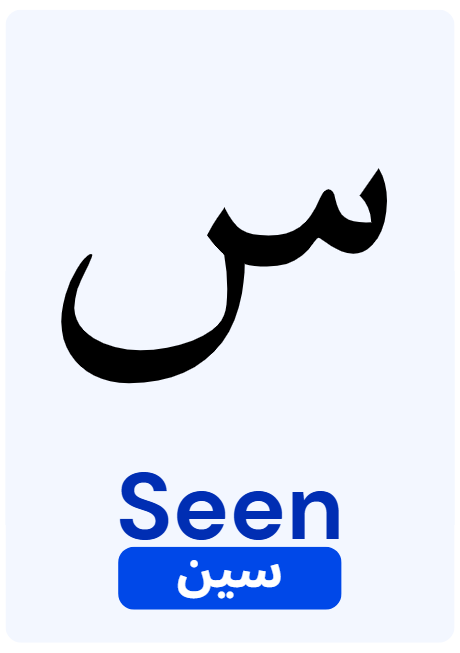
Seen (س) | Alphabet in Arabic
Arabic Letter
س
Letter Name
Seen
Pronunciation
Sa
Listen to the pronunciation
How to Pronounce Seen
Seen is the twelfth letter in the alphabet in Arabic. It produces a soft “s” sound, similar to the S in the English words sun, snake, and smile.
To pronounce Seen correctly, place the tip of your tongue close to the back of your upper front teeth without touching them firmly. Allow the air to flow smoothly between your tongue and teeth while saying Sa.
For English speakers, Seen is one of the easiest letters in the alphabet in Arabic because its pronunciation is almost identical to the English letter S.
Example Words
سمك (Fish)
سيارة (Car)
سلام (Peace)
Common Mistakes
Many beginners confuse Seen (س) with Saad (ص) because both letters are often written as S in English transliteration.
Remember that Seen is a light and soft S sound, just like the S in the English word sun. It should never sound deep or heavy like Saad (ص), which you will learn later in this guide.
Listen carefully to the audio and repeat the example words until you can clearly hear the difference between Seen and Saad.
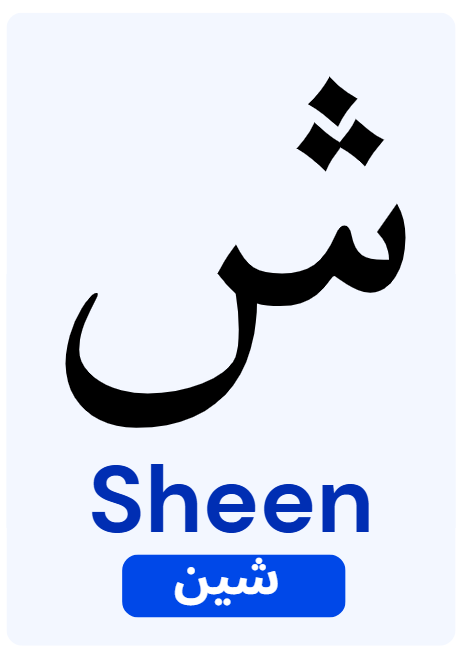
Sheen (ش) | Alphabet in Arabic
Arabic Letter
ش
Letter Name
Sheen
Pronunciation
Sha
Listen to the pronunciation
How to Pronounce Sheen
Sheen is the thirteenth letter in the alphabet in Arabic. It produces the “sh” sound, similar to the SH in the English words ship, shoe, and sheep.
To pronounce Sheen correctly, place your tongue close to the roof of your mouth without touching it completely, then allow the air to flow smoothly while saying Sha.
For English speakers, Sheen is one of the easiest letters in the alphabet in Arabic because it sounds almost exactly like the English SH sound.
Example Words
شمس (Sun)
شجرة (Tree)
شارع (Street)
Common Mistakes
Most beginners pronounce Sheen correctly because the sound is very similar to the English SH.
However, some learners confuse Sheen (ش) with Seen (س). Remember that Sheen always has the SH sound, while Seen has the regular S sound.
Listen carefully to the audio and repeat the example words several times until you can clearly distinguish between Seen and Sheen.
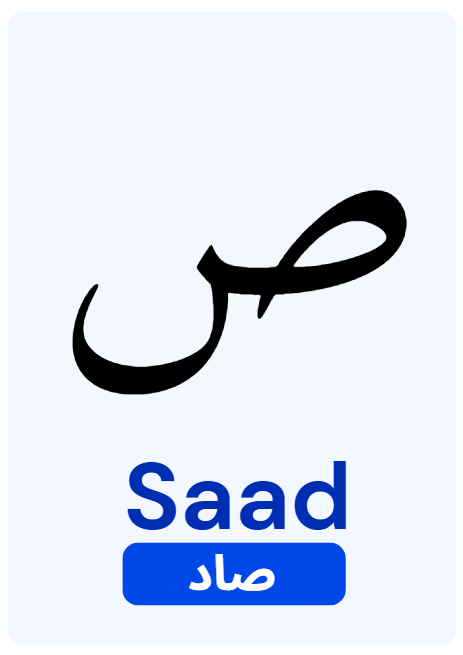
Saad (ص) | Alphabet in Arabic
Arabic Letter
ص
Letter Name
Saad
Pronunciation
Saa
Listen to the pronunciation
How to Pronounce Saad
Saad is the fourteenth letter in the alphabet in Arabic. It produces a deep and heavy “s” sound. While it may sound similar to the English letter S, the Arabic Saad is pronounced with the back of the tongue raised slightly, giving it a fuller and stronger sound.
To pronounce Saad correctly, begin with the regular S sound, then make it deeper by lifting the back of your tongue slightly toward the roof of your mouth. Your lips should remain relaxed while saying Saa.
For many English speakers, Saad is one of the first “heavy letters” in the alphabet in Arabic, so it may require extra listening and practice.
Example Words
صبر (Patience)
صلاة (Prayer)
صديق (Friend)
Common Mistakes
Many beginners pronounce Saad exactly like Seen (س) because both letters are often written as S in English.
Remember that Seen is a light S sound, while Saad is deeper, stronger, and heavier. Try listening to both letters several times to hear the difference clearly.
Practice the example words aloud until you can naturally distinguish between Seen (س) and Saad (ص).
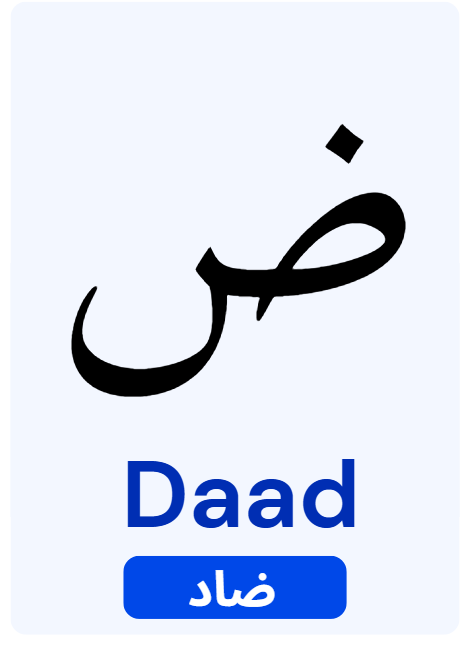
Daad (ض) | Alphabet in Arabic
Arabic Letter
ض
Letter Name
Daad
Pronunciation
Daa
Listen to the pronunciation
How to Pronounce Daad
Daad is the fifteenth letter in the alphabet in Arabic. It produces a deep and heavy “d” sound that does not exist in English. In fact, Arabic is often called “The Language of Daad” because this unique letter is rarely found in other languages.
To pronounce Daad correctly, begin with the regular D sound, then raise the back of your tongue slightly toward the roof of your mouth to create a deeper and fuller pronunciation. The sound should be strong but natural, without forcing your voice.
For many English speakers, Daad is one of the most challenging letters in the alphabet in Arabic. Don’t worry if it feels difficult at first. With regular listening and practice, your pronunciation will improve.
Example Words
ضوء (Light)
ضيف (Guest)
ضفدع (Frog)
Common Mistakes
Many beginners pronounce Daad exactly like Daal (د) because both letters are represented by the letter D in English transliteration.
Remember that Daal is a light D sound, while Daad is much deeper and heavier. Listen carefully to the audio and compare the two letters until you can clearly hear the difference.
Practice the example words several times and focus on making the sound full and strong without exaggerating it.
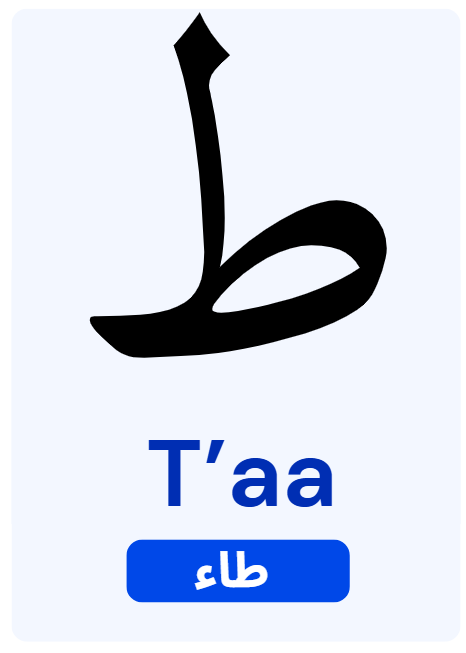
Taa (ط) | Alphabet in Arabic
Arabic Letter
ط
Letter Name
Taa
Pronunciation
Taa
Listen to the pronunciation
How to Pronounce Taa
Taa is the sixteenth letter in the alphabet in Arabic. It produces a deep and heavy “t” sound. Although it may look similar to the English letter T, the Arabic Taa (ط) is pronounced with a stronger and fuller sound.
To pronounce Taa correctly, place the tip of your tongue behind your upper front teeth, just as you would for the letter Taa (ت). Then raise the back of your tongue slightly toward the roof of your mouth to create a heavier sound.
For English speakers, Taa is another one of the heavy letters in the alphabet in Arabic. It may take a little practice to hear the difference between Taa (ت) and Taa (ط).
Example Words
طالب (Student)
طعام (Food)
طريق (Road)
Common Mistakes
Many beginners pronounce Taa (ط) exactly like Taa (ت).
Remember that Taa (ت) is a light T sound, while Taa (ط) is deeper, heavier, and produced with the back of the tongue slightly raised.
Listen carefully to the audio and compare both letters several times until you can clearly hear and pronounce the difference. Practice the example words slowly before moving to the next letter.
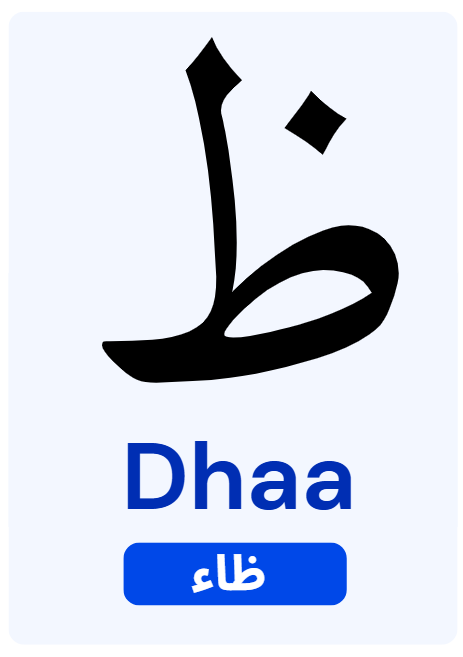
Dhaa (ظ) | Alphabet in Arabic
Arabic Letter
ظ
Letter Name
Dhaa
Pronunciation
Dhaa
Listen to the pronunciation
How to Pronounce Dhaa
Dhaa is the seventeenth letter in the alphabet in Arabic. It produces a deep and heavy “Dh” sound, similar to the DH in the English word Abou Dhabee, but with a stronger and fuller pronunciation.
To pronounce Dhaa correctly, gently place the tip of your tongue between your upper and lower front teeth, just as you would for Thaal (ذ). Then raise the back of your tongue slightly toward the roof of your mouth to create the deep Arabic sound.
For many English speakers, Dhaa is one of the more challenging letters in the alphabet in Arabic because English does not have an exact equivalent. Listening carefully and practicing regularly will help you master this unique pronunciation.
Example Words
ظرف (Envelope)
ظهر (Back)
ظن (Thought)
Common Mistakes
Many beginners pronounce Dhaa (ظ) exactly like Thaal (ذ) or Zay (ز).
Remember that Thaal (ذ) has a light TH sound like the English word this, while Dhaa (ظ) is much deeper and heavier. It should sound strong without becoming harsh.
Listen carefully to the audio and compare ذ and ظ several times until you can clearly hear the difference. Practice the example words slowly before moving on to the next letter.
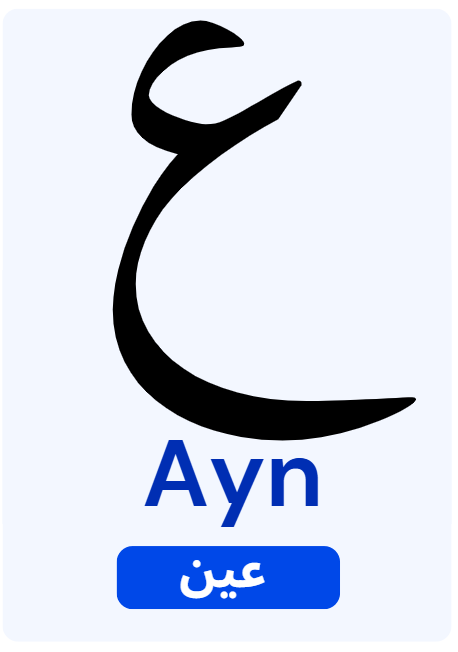
Ain (ع) | Alphabet in Arabic
Arabic Letter
ع
Letter Name
Ain
Pronunciation
ʿA
Listen to the pronunciation
How to Pronounce Ain
Ain is the eighteenth letter in the alphabet in Arabic. It is one of the most unique letters in the Arabic language because it has no exact equivalent in English.
To pronounce Ain correctly, use the middle part of your throat to produce a gentle, voiced sound. Your mouth should remain relaxed, and the sound should come naturally from inside the throat without forcing it.
For many English speakers, Ain is one of the most difficult letters in the alphabet in Arabic. Do not worry if it feels unusual at first. With regular listening and practice, your pronunciation will improve over time.
Example Words
عين (Eye)
عربي (Arabic)
علم (Knowledge)
Common Mistakes
Many beginners either skip the sound completely or pronounce Ain like the English letter A.
Remember that Ain is not a regular vowel. It is a unique Arabic letter produced from the throat and should always be pronounced clearly, even though it may feel unfamiliar.
Listen carefully to the audio and repeat the example words several times. With consistent practice, you will begin to recognize and pronounce this important Arabic letter naturally.
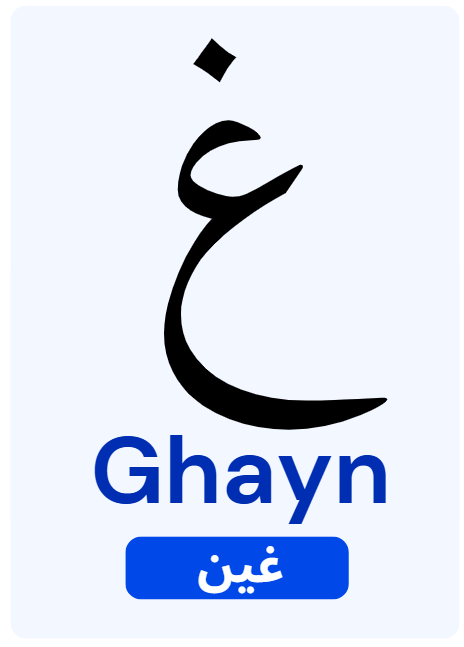
Ghayn (غ) | Alphabet in Arabic
Arabic Letter
غ
Letter Name
Ghayn
Pronunciation
Gh
Listen to the pronunciation
How to Pronounce Ghayn
Ghayn is the nineteenth letter in the alphabet in Arabic. It produces a deep “gh” sound that comes from the upper part of the throat. This sound does not exist in standard English, so it may feel unfamiliar when you first learn it.
To pronounce Ghayn correctly, allow your voice to vibrate while gently letting the air pass through the back of your throat. Unlike Khaa (خ), which is unvoiced, Ghayn (غ) is a voiced letter, meaning you should feel your vocal cords vibrating as you pronounce it.
For many English speakers, Ghayn is one of the most challenging letters in the alphabet in Arabic. With careful listening and regular practice, you will gradually become comfortable producing this unique sound.
Example Words
غابة (Forest)
غرفة (Room)
غيم (Cloud)
Common Mistakes
Many beginners pronounce Ghayn like the English letter G or confuse it with Khaa (خ).
Remember that Ghayn is a voiced throat letter, while Khaa is unvoiced. The two letters are produced from almost the same place, but Ghayn should include vibration from your vocal cords.
Listen carefully to the audio and compare خ and غ several times until you can clearly hear the difference. Practice the example words slowly until the pronunciation feels natural.
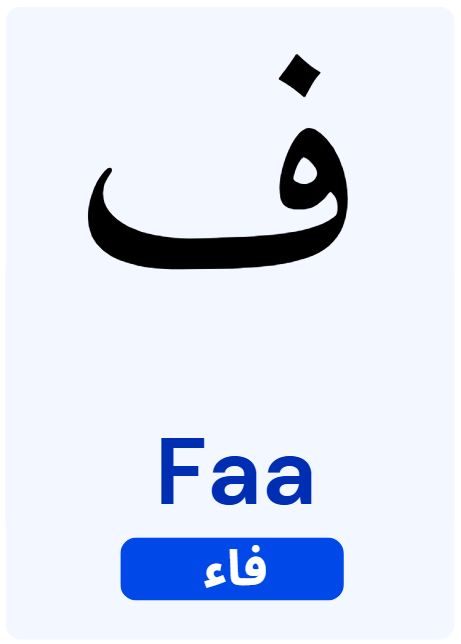
Faa (ف) | Alphabet in Arabic
Arabic Letter
ف
Letter Name
Faa
Pronunciation
Fa
Listen to the pronunciation
How to Pronounce Faa
Faa is the twentieth letter in the alphabet in Arabic. It produces the “f” sound, similar to the F in the English words fish, family, and flower.
To pronounce Faa correctly, gently place your upper front teeth on your lower lip and allow the air to flow smoothly while saying Fa.
For English speakers, Faa is one of the easiest letters in the alphabet in Arabic because its pronunciation is almost identical to the English letter F.
Example Words
فم (Mouth)
فيل (Elephant)
فاكهة (Fruit)
Common Mistakes
Most beginners pronounce Faa correctly because the sound is very similar to the English letter F.
However, some learners pronounce it too softly, making it sound weak. Remember that Faa should have a clear and steady F sound with a smooth flow of air between your upper teeth and lower lip.
Listen carefully to the audio and repeat the example words several times until you can pronounce the letter naturally and confidently.
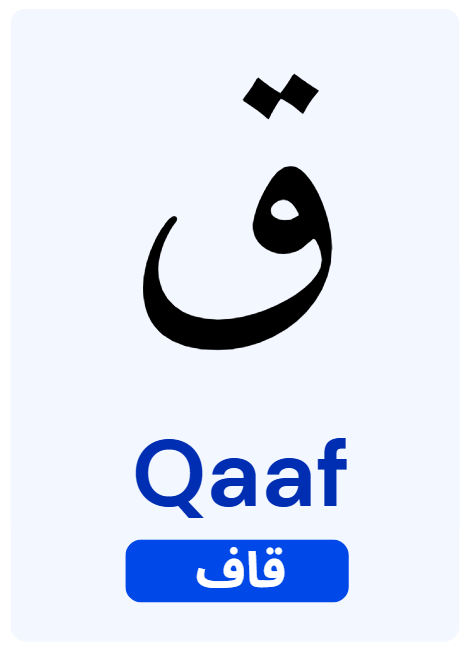
Qaaf (ق) | Alphabet in Arabic
Arabic Letter
ق
Letter Name
Qaaf
Pronunciation
Qa
Listen to the pronunciation
How to Pronounce Qaaf
Qaaf is the twenty-first letter in the alphabet in Arabic. It produces a deep “q” sound that comes from the back of the tongue touching the soft palate near the throat. This sound does not exist in standard English, so it may feel unfamiliar at first.
To pronounce Qaaf correctly, raise the back of your tongue toward the soft palate, then release the sound firmly while saying Qa. The sound should be clear and strong, but it should not come from the throat.
For many English speakers, Qaaf is one of the more challenging letters in the alphabet in Arabic because it is often confused with Kaaf (ك). Listening carefully to the audio will help you recognize the difference.
Example Words
قلم (Pen)
قمر (Moon)
قرآن (Quran)
Common Mistakes
Many beginners pronounce Qaaf exactly like Kaaf (ك) because both letters may sound similar to English speakers.
Remember that Qaaf is pronounced farther back in the mouth than Kaaf. It has a deeper and stronger sound, while Kaaf is lighter and comes from a position closer to the front of the mouth.
Listen carefully to the audio and compare ق and ك several times until you can clearly hear and pronounce the difference. Practice the example words slowly before moving to the next letter.
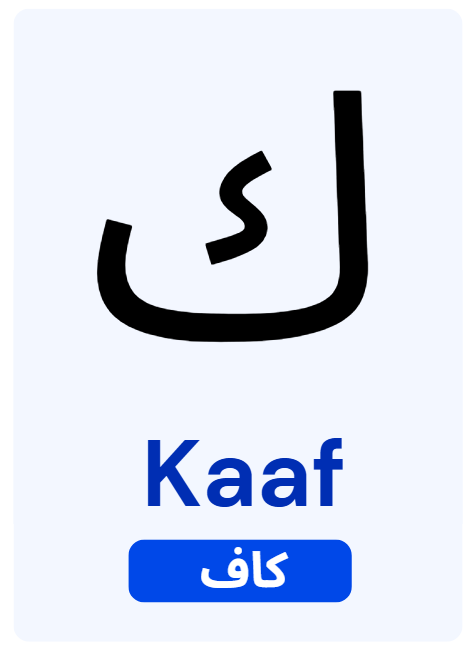
Kaaf (ك) | Alphabet in Arabic
Arabic Letter
ك
Letter Name
Kaaf
Pronunciation
Ka
Listen to the pronunciation
How to Pronounce Kaaf
Kaaf is the twenty-second letter in the alphabet in Arabic. It produces the “k” sound, similar to the K in the English words kite, key, and king.
To pronounce Kaaf correctly, raise the back of your tongue toward the soft palate, then release the air gently while saying Ka. The sound should be light and clear.
For English speakers, Kaaf is one of the easiest letters in the alphabet in Arabic because its pronunciation is almost identical to the English letter K.
Example Words
كتاب (Book)
كلب (Dog)
كبير (Big)
Common Mistakes
Many beginners confuse Kaaf (ك) with Qaaf (ق) because both letters are produced near the back of the mouth.
Remember that Kaaf is lighter and softer, while Qaaf is deeper and stronger. Kaaf should sound just like the K in the English word kite, without adding extra force.
Listen carefully to the audio and compare ك and ق several times until you can clearly hear the difference. Practice the example words slowly until you can pronounce the letter naturally and confidently.
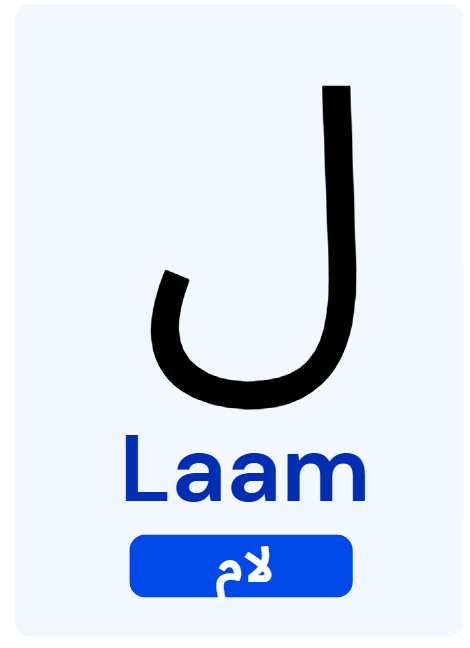
Laam (ل) | Alphabet in Arabic
Arabic Letter
ل
Letter Name
Laam
Pronunciation
La
Listen to the pronunciation
How to Pronounce Laam
Laam is the twenty-third letter in the alphabet in Arabic. It produces the “l” sound, similar to the L in the English words lamp, love, and leaf.
To pronounce Laam correctly, gently place the tip of your tongue against the ridge just behind your upper front teeth, then allow your voice to flow smoothly while saying La.
For English speakers, Laam is one of the easiest letters in the alphabet in Arabic because its pronunciation is very close to the English letter L.
Example Words
لبن (Milk)
ليمون (Lemon)
لغة (Language)
Common Mistakes
Most beginners pronounce Laam correctly because it is very similar to the English letter L.
However, some learners press their tongue too hard against the roof of the mouth, making the sound feel unnatural. Remember that Laam should be light, smooth, and relaxed.
Listen carefully to the audio and repeat the example words several times until you can pronounce the letter naturally and confidently.
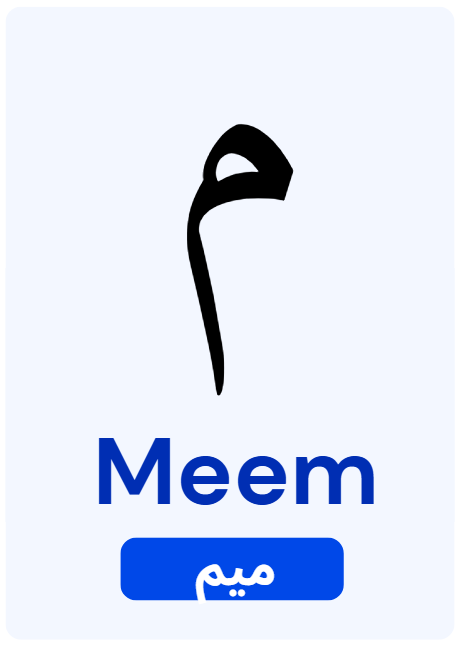
Meem (م) | Alphabet in Arabic
Arabic Letter
م
Letter Name
Meem
Pronunciation
Ma
Listen to the pronunciation
How to Pronounce Meem
Meem is the twenty-fourth letter in the alphabet in Arabic. It produces the “m” sound, similar to the M in the English words moon, mother, and milk.
To pronounce Meem correctly, gently close both lips together, then allow your voice to pass through your nose while saying Ma. The sound should be smooth, clear, and natural.
For English speakers, Meem is one of the easiest letters in the alphabet in Arabic because its pronunciation is almost identical to the English letter M.
Example Words
ماء (Water)
مسجد (Mosque)
مفتاح (Key)
Common Mistakes
Most beginners pronounce Meem correctly because it is very similar to the English letter M.
However, some learners do not fully close their lips before producing the sound, making the pronunciation unclear. Remember that your lips should touch gently before releasing the sound.
Listen carefully to the audio and repeat the example words several times until you can pronounce the letter naturally and confidently.
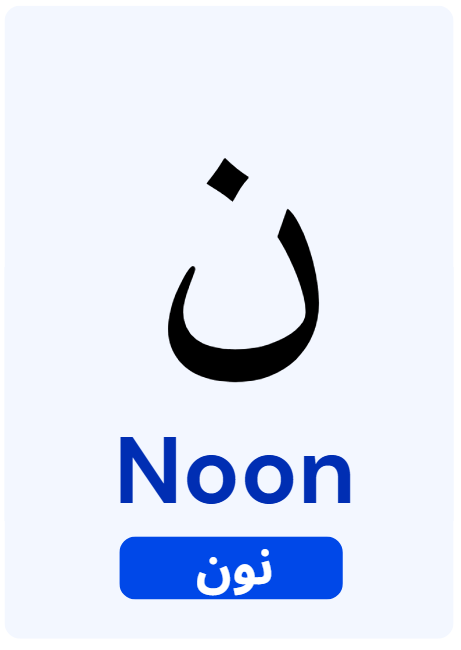
Noon (ن) | Alphabet in Arabic
Arabic Letter
ن
Letter Name
Noon
Pronunciation
Na
Listen to the pronunciation
How to Pronounce Noon
Noon is the twenty-fifth letter in the alphabet in Arabic. It produces the “n” sound, similar to the N in the English words name, nose, and night.
To pronounce Noon correctly, gently place the tip of your tongue against the ridge just behind your upper front teeth while allowing the sound to resonate through your nose. The pronunciation should be smooth, clear, and natural.
For English speakers, Noon is one of the easiest letters in the alphabet in Arabic because its pronunciation is almost identical to the English letter N.
Example Words
نور (Light)
نهر (River)
نجم (Star)
Common Mistakes
Most beginners pronounce Noon correctly because it is very similar to the English letter N.
However, some learners do not allow enough sound to pass through the nose, making the pronunciation less natural. Remember that Noon is a nasal sound, so you should feel a gentle vibration around your nose while pronouncing it.
Listen carefully to the audio and repeat the example words several times until you can pronounce the letter naturally and confidently.
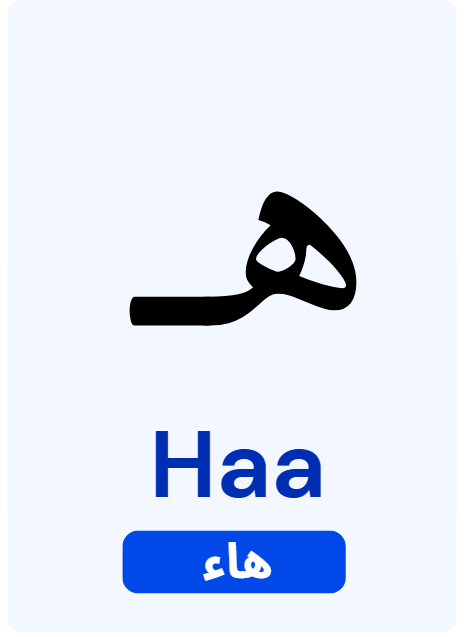
Haa (هـ) | Alphabet in Arabic
Arabic Letter
هـ
Letter Name
Haa
Pronunciation
Ha
Listen to the pronunciation
How to Pronounce Haa
Haa is the twenty-sixth letter in the alphabet in Arabic. It produces a soft “h” sound, similar to the H in the English words house, help, and happy.
To pronounce Haa correctly, gently allow the air to flow through your mouth without using your throat. The sound should be light, relaxed, and effortless.
For English speakers, Haa is one of the easiest letters in the alphabet in Arabic because its pronunciation is almost identical to the English letter H.
Example Words
هواء (Air)
هدية (Gift)
هلال (Crescent)
Common Mistakes
Many beginners confuse Haa (هـ) with Haa (ح) because both are often represented by the letter H in English.
Remember that هـ is a light H sound, just like the H in the English word house. The letter ح, on the other hand, comes from the middle of the throat and has a deeper pronunciation.
Listen carefully to the audio and compare هـ and ح several times until you can clearly hear the difference. Practice the example words slowly before moving to the next letter.
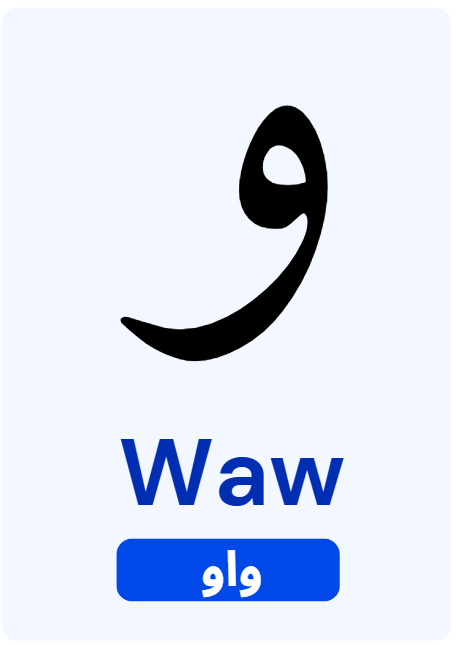
Waw (و) | Alphabet in Arabic
Arabic Letter
و
Letter Name
Waw
Pronunciation
Wa
Listen to the pronunciation
How to Pronounce Waw
Waw is the twenty-seventh letter in the alphabet in Arabic. It produces the “w” sound, similar to the W in the English words water, window, and welcome.
To pronounce Waw correctly, gently round your lips and allow the sound to flow smoothly while saying Wa. Your lips should form a small circle without pressing them tightly together.
For English speakers, Waw is one of the easiest letters in the alphabet in Arabic because its pronunciation is almost identical to the English letter W.
Example Words
ولد (Boy)
وردة (Rose)
وجه (Face)
Common Mistakes
Most beginners pronounce Waw correctly because it is very similar to the English letter W.
However, some learners confuse Waw (و) with the long vowel sound Oo because the same letter is also used as a long vowel in Arabic. When Waw is a consonant, it should always begin with a clear W sound, just like the W in the English word water.
Listen carefully to the audio and repeat the example words several times until you can pronounce the letter naturally and confidently.
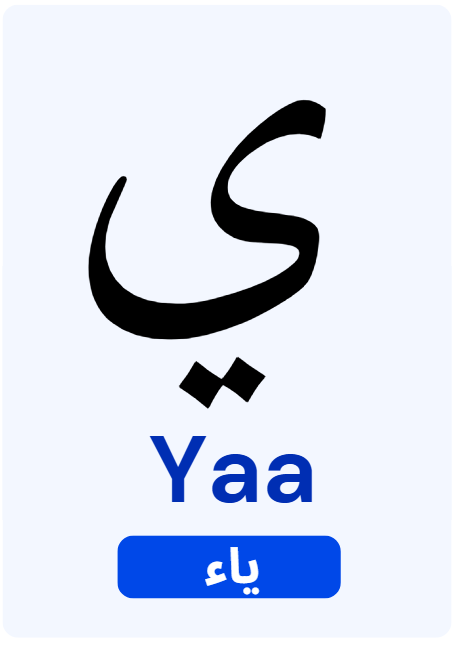
Yaa (ي) | Alphabet in Arabic
Arabic Letter
ي
Letter Name
Yaa
Pronunciation
Ya
Listen to the pronunciation
How to Pronounce Yaa
Yaa is the twenty-eighth and final letter in the alphabet in Arabic. It produces the “y” sound, similar to the Y in the English words yes, yellow, and young.
To pronounce Yaa correctly, raise the middle of your tongue slightly toward the roof of your mouth while allowing the sound to flow smoothly. The pronunciation should be soft, clear, and natural.
For English speakers, Yaa is one of the easiest letters in the alphabet in Arabic because its pronunciation is almost identical to the English letter Y.
Example Words
يد (Hand)
يوم (Day)
يمين (Right)
Common Mistakes
Most beginners pronounce Yaa correctly because it is very similar to the English letter Y.
However, some learners confuse Yaa (ي) with the long vowel sound Ee because the same letter is also used as a long vowel in Arabic. When Yaa is used as a consonant, it should always begin with a clear Y sound, just like the Y in the English word yes.
Listen carefully to the audio and repeat the example words several times until you can pronounce the letter naturally and confidently.
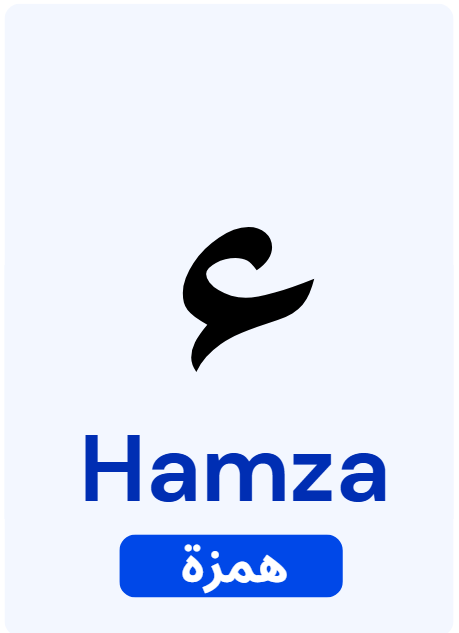
Hamza (ء) | Alphabet in Arabic
Arabic Letter
ء
Letter Name
Hamza
Pronunciation
ʾA
Listen to the pronunciation
How to Pronounce Hamza
Hamza is a special letter in the alphabet in Arabic. It represents a short stop in the voice, known as a glottal stop. This sound is common in English, although many people do not realize they already use it.
For example, when some English speakers pronounce the expression “uh-oh,” there is a brief stop between the two sounds. That short pause is very similar to the sound of Hamza.
To pronounce Hamza correctly, briefly stop the airflow in your throat before releasing the next vowel sound. The stop should be quick and gentle, not long or exaggerated.
Hamza can appear at the beginning, middle, or end of a word. It may also be written on different “seats,” such as أ, إ, ؤ, ئ, or written by itself as ء, depending on Arabic spelling rules.
Example Words
أب (Father)
إسلام (Islam)
سؤال (Question)
Common Mistakes
Many beginners ignore the Hamza completely and pronounce the word without the short stop.
Others think Hamza is simply the letter Alif, but they are not the same. Alif (ا) is a letter, while Hamza (ء) represents a distinct consonant sound that can be written in different forms.
Listen carefully to the audio and practice the example words until you can hear and produce the short stop naturally.
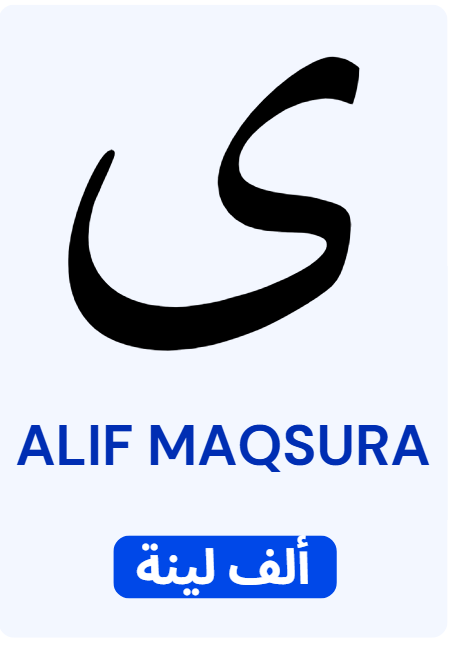
Alif Maqsurah (ى) | Alphabet in Arabic
Arabic Letter
ى
Letter Name
Alif Laynah
Pronunciation
Aa
Listen to the pronunciation
How to Pronounce Alif Laynah
Alif Laynah is a special letter in the alphabet in Arabic. Although it looks similar to Yaa (ي) without the two dots, it is not pronounced like Yaa. Instead, it produces a long “aa” sound, just like the regular Alif (ا).
You will usually find Alif Laynah at the end of Arabic words. It never appears at the beginning or in the middle of a word.
For English speakers, the pronunciation of Alif Laynah is simple because it sounds like the “a” in the English word father.
Example Words
هدى (Guidance)
موسى (Moses)
فتى (Young man)
Common Mistakes
Many beginners confuse Alif Laynah (ى) with Yaa (ي) because the two letters look very similar.
Remember that Alif Laynah has the same pronunciation as Alif (ا) and produces a long “aa” sound. It should never be pronounced as “ya”.
Listen carefully to the audio and repeat the example words until you can confidently recognize and pronounce the difference between Alif Laynah (ى) and Yaa (ي).
Taa Marbutah (ة) | Alphabet in Arabic
Arabic Letter
ة
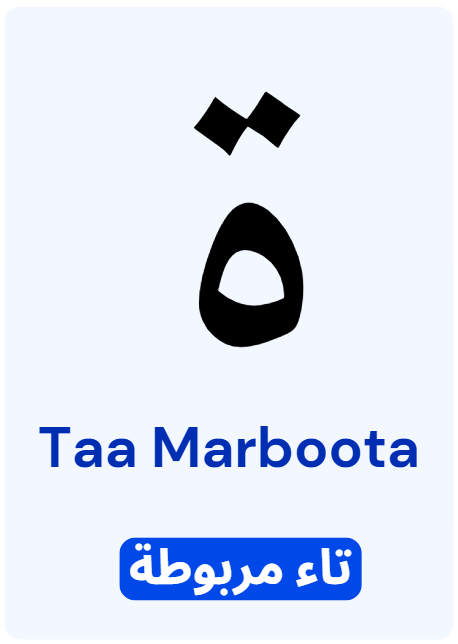
Letter Name
Taa Marbutah
Pronunciation
Ta
Listen to the pronunciation
How to Pronounce Taa Marbutah
Taa Marbutah is a special letter in the alphabet in Arabic. It usually appears only at the end of a word and is commonly used in many feminine nouns.
When you read a word by itself or continue reading in a sentence, Taa Marbutah is usually pronounced as “Ta.” However, when you stop at the end of the word, it is often pronounced as a soft “Ah” sound.
For beginners learning the alphabet in Arabic, this may seem confusing at first, but it becomes natural with regular reading and listening.
Example Words
مدرسة (School)
سيارة (Car)
جنة (Paradise)
Common Mistakes
Many beginners confuse Taa Marbutah (ة) with the regular Taa (ت) because both can produce the “Ta” sound.
Remember that Taa Marbutah appears only at the end of words and has a special pronunciation rule. When you stop reading, it is usually pronounced as “Ah.” When you continue reading, it is pronounced as “Ta.”
Listen carefully to the audio and practice reading the example words both ways. First, read each word by itself, then read it as part of a sentence to hear the difference naturally.
Lam Alif (لا) | Alphabet in Arabic
Arabic Letter
لا
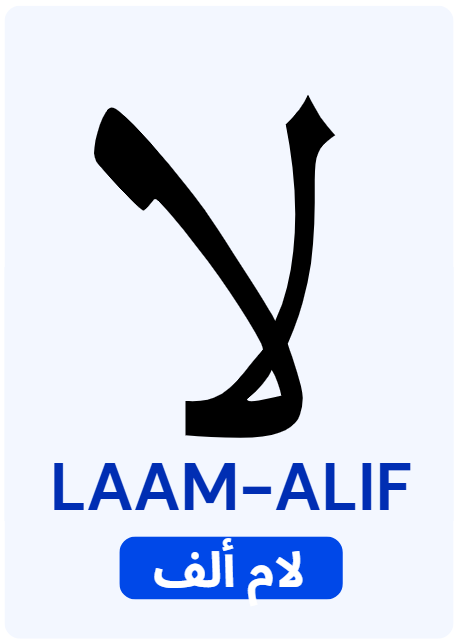
Letter Name
Lam Alif
Pronunciation
La
Listen to the pronunciation
How to Pronounce Lam Alif
Lam Alif is a special combination in the alphabet in Arabic. It is formed when the letter Laam (ل) is immediately followed by Alif (ا). Instead of being written as two separate letters, they join together to create the unique shape لا.
To pronounce Lam Alif correctly, simply combine the L sound of Laam with the long Aa sound of Alif, producing Laa.
For English speakers, Lam Alif is easy to pronounce because it sounds very similar to the “la” in the English word last, but with a longer Aa sound.
Example Words
لا (No)
سلام (Peace)
كتاب لا (No book)
Common Mistakes
Some beginners think Lam Alif (لا) is a completely new letter.
Remember that Lam Alif is not a separate letter. It is a special ligature created by combining Laam (ل) and Alif (ا) into one connected shape.
Another common mistake is pronouncing it with a short La sound. Instead, make sure to hold the vowel slightly longer so it sounds Laa.
Listen carefully to the audio and repeat the example words until you can recognize and pronounce Lam Alif naturally.
Arabic Alphabet for Beginners
If you are looking for an Arabic alphabet guide, learning the 28 letters is the best place to start. Each Arabic letter has its own shape and pronunciation, and most letters change their form depending on where they appear in a word.
Some beginners also search for Arabic to Alphabet resources when they want to understand how Arabic letters correspond to familiar English sounds. While Arabic pronunciation cannot always be represented perfectly with English letters, learning the correct Arabic sounds alongside their English approximations can make the alphabet much easier to remember.
In this guide, you will learn the alphabet Arabic beginners need to recognize, pronounce, and eventually combine into complete Arabic words.
How Arabic Letters Change Shape
| Isolated | Beginning | Middle | End |
|---|---|---|---|
| ب | بـ | ـبـ | ـب |
| ت | تـ | ـتـ | ـت |
| ث | ثـ | ـثـ | ـث |
Arabic Letters That Connect on Both Sides
Most letters in the alphabet in Arabic connect to both the letter before them and the letter after them. This is one of the unique features of Arabic writing and helps create the beautiful connected script.
Examples include:
ب ت ث ج ح خ س ش ص ض ط ظ ع غ ف ق ك ل م ن هـ ي
Once you learn these connections, reading Arabic words becomes much easier.
Arabic Letters That Connect Only on the Right Side
Some letters in the alphabet in Arabic connect only to the letter before them and never connect to the following letter.
These letters are:
ا د ذ ر ز و ى ة
When one of these letters appears in a word, the next letter starts a new shape instead of connecting to it.
Similar Arabic Letters
Some Arabic letters look very similar. The easiest way to learn them is by studying them in groups.
- ب ت ث
- ج ح خ
- د ذ
- ر ز
- س ش
- ص ض
- ط ظ
- ع غ
- ف ق
- هـ ة
Focus on the dots and pronunciation, and you’ll quickly recognize the difference between each letter.
Arabic Alphabet with Audio Practice
Every letter in this guide includes an audio button so you can hear the correct pronunciation.
For the best results:
- Listen carefully.
- Repeat the sound five times.
- Read the example words aloud.
- Move on only when you feel comfortable with the pronunciation.
Just 10 to 15 minutes of daily practice can make a significant difference in your Arabic reading skills.
Frequently Asked Questions for Arabic alphabet
How many letters are in the Arabic alphabet?
The Arabic alphabet has 28 letters.
Is Arabic written from right to left?
Yes. Arabic is always written and read from right to left.
Which Arabic letter is the hardest to pronounce?
Many beginners find Ain (ع), Ghayn (غ), Qaaf (ق), Daad (ض), and Dhaa (ظ) the most challenging because these sounds do not exist in English.
Do Arabic letters change their shape?
Yes. Most Arabic letters change their shape depending on whether they appear at the beginning, middle, or end of a word.
Are there capital letters in Arabic?
No. Arabic does not have uppercase or lowercase letters.
Why do some Arabic letters not connect?
Letters such as ا، د، ذ، ر، ز، و، ى connect only to the letter before them, not the one after them.
What is the best way to learn the Arabic alphabet?
The best method is to learn one or two letters each day, listen to their pronunciation, and practice reading simple words regularly.
How long does it take to learn the Arabic alphabet?
Most beginners can learn all 28 letters within a few weeks with consistent daily practice.
Is this guide suitable for Quran reading?
Yes. This guide teaches the Modern Standard Arabic alphabet used for reading the Quran and formal Arabic.
What should I learn after the Arabic alphabet?
After learning the letters, the next step is understanding how letters connect, followed by Harakat (short vowels) and simple reading practice.
What is the Arabic alphabet?
The Arabic alphabet consists of 28 primary letters written from right to left. If you are searching for an Arabic alphabet or alphabet Arabic guide, learning these letters and their sounds is the foundation for reading Arabic words.
What does Arabic to Alphabet mean?
Arabic to Alphabet can refer to learning how Arabic sounds and words are represented using letters. For beginners, the most important step is to learn the actual Arabic alphabet first, then understand how Arabic letters combine to form words and how their sounds can be represented in English.
Final Thoughts
Congratulations! You have now learned the complete alphabet in Arabic and taken the first step toward reading Arabic with confidence.
This guide is part of Arabic MASTERY, a step-by-step learning system designed to help beginners master Arabic reading in a simple and enjoyable way.
Keep practicing every day, listen to the pronunciation of each letter, and review the example words regularly. Small, consistent practice leads to steady progress.
Your Next Step
Now that you know all the Arabic letters, it’s time to start reading real words.
Continue your learning journey with our complete beginner course:
👉 Learn to Read Arabic Step by Step
You’ll discover how Arabic letters connect to form words, learn Harakat (short vowels), and begin reading Arabic confidently from your very first lessons.