
All Prophets Names in Islam are among the most searched Islamic topics because every Muslim believes that Allah sent prophets to guide humanity toward worshipping Him alone. From Prophet Adam (AS) to Prophet Muhammad ﷺ, every prophet delivered the same message of faith, righteousness, and obedience to Allah.
Before learning about the prophets, it is helpful to understand the Holy Quran, the final revelation that mentions many of their stories. Read this beginner-friendly introduction to the Quran:
If you’re interested in strengthening your daily relationship with the Quran after learning about the prophets, don’t miss our detailed guide on Surahs to Read After Fajr, where you’ll discover recommended chapters to recite every morning and the virtues behind them:
Who Are the Prophets in Islam?
The All Prophets Names in Islam represent individuals chosen by Allah to guide mankind toward the truth. Every prophet taught people to worship Allah alone without partners and encouraged honesty, kindness, justice, and good character.
Muslims believe there is no contradiction between the prophets. Instead, they were part of one continuous chain of guidance sent by Allah to different nations throughout history.
Although languages, cultures, and laws varied, their core message remained exactly the same:
Worship Allah alone.
The Quran repeatedly reminds believers that every prophet was sent as a mercy and a guide for his people.
Why Did Allah Send Prophets?
Understanding the All Prophets Names in Islam becomes much easier when we understand why prophets were sent in the first place.
Allah sent prophets to:
- Teach people Tawhid (belief in One God).
- Explain right from wrong.
- Establish justice.
- Give hope through repentance.
- Warn against oppression and disbelief.
- Show practical examples of righteous living.
Every prophet lived among his people and understood their language, customs, and challenges.
Because of this, their stories remain relevant today.
Complete List of All Prophets Names in Islam
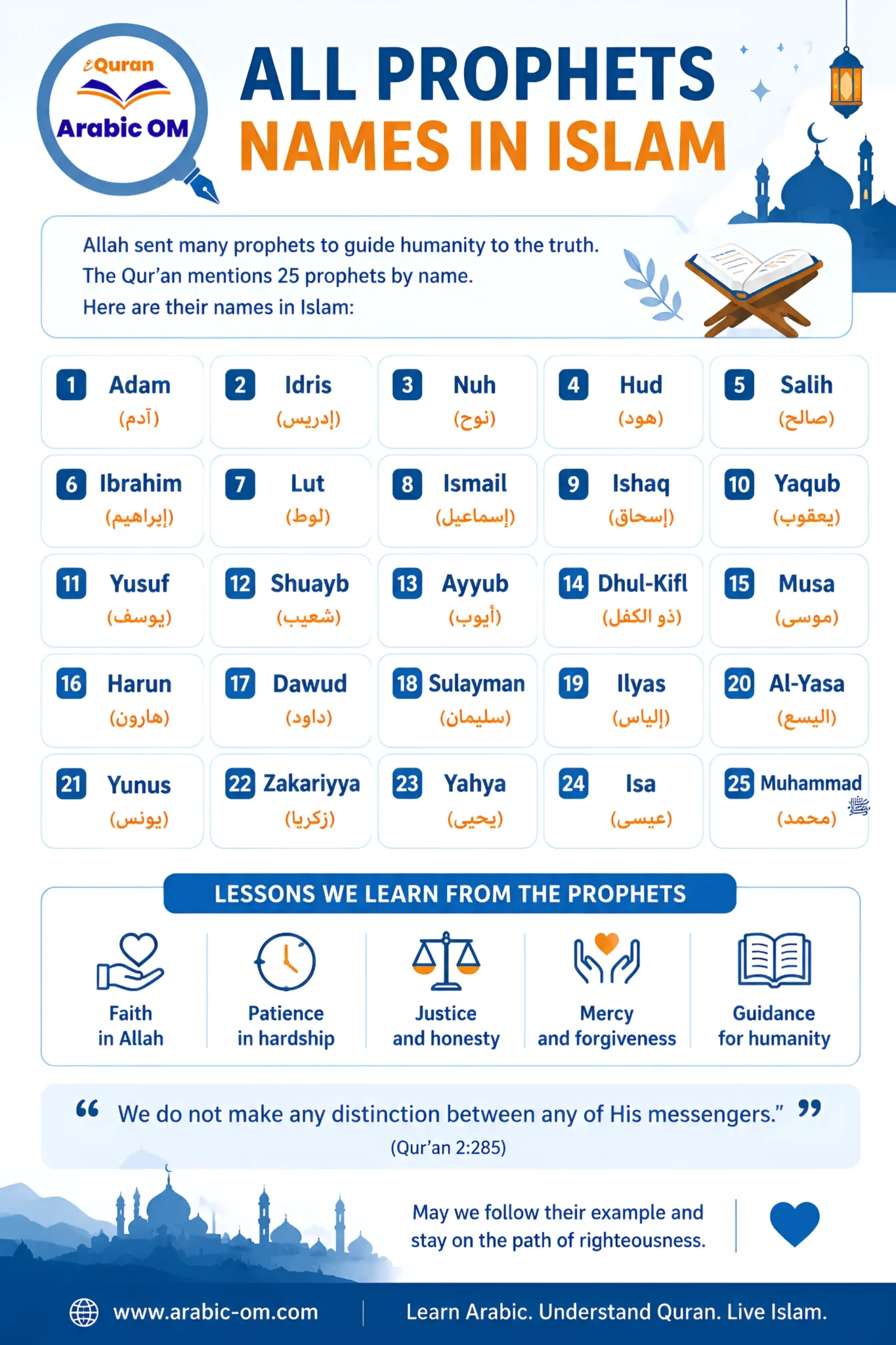
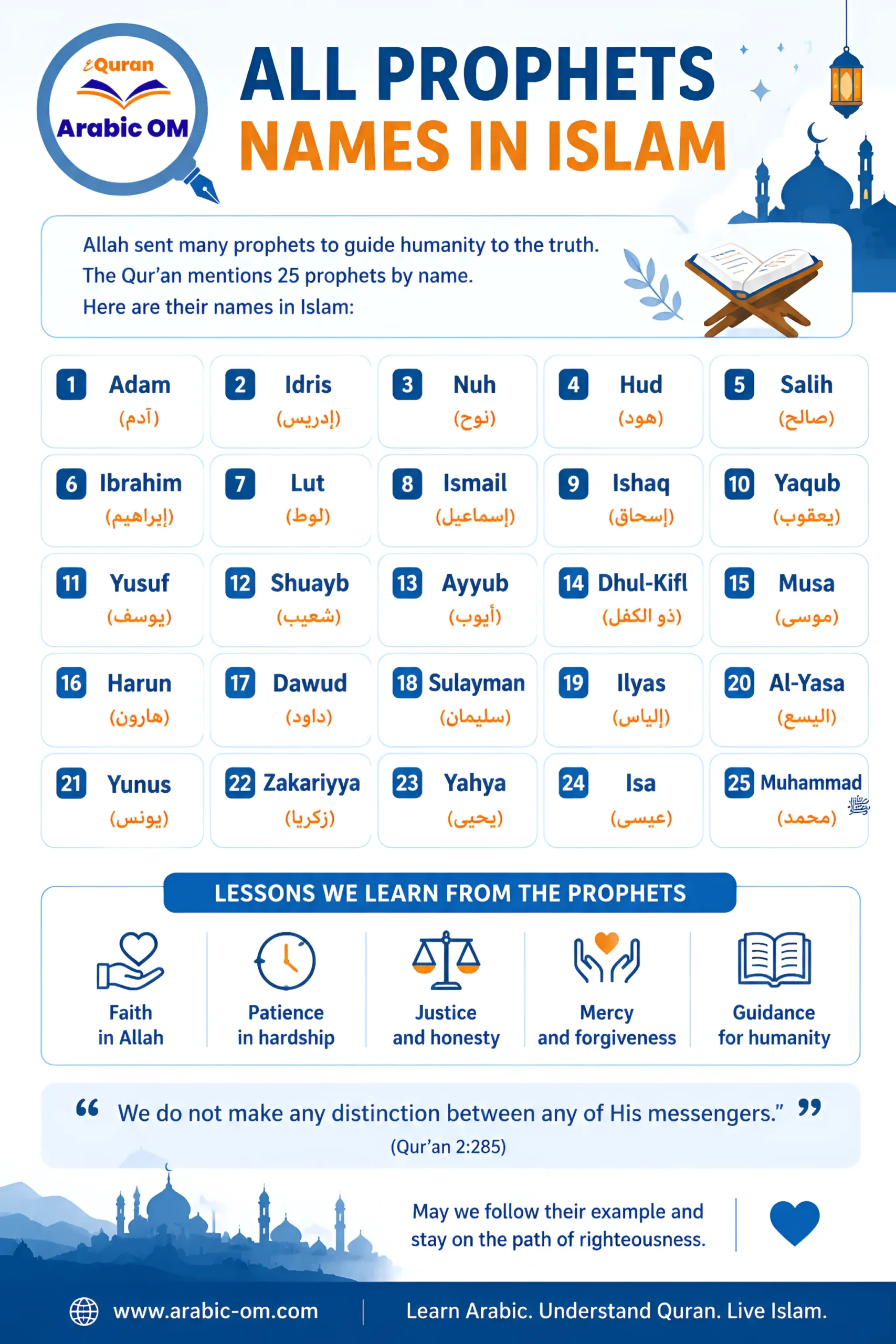
The Quran mentions twenty-five prophets by name.
| Order | Prophet |
| 1 | Adam (AS) |
| 2 | Idris (AS) |
| 3 | Nuh (AS) |
| 4 | Hud (AS) |
| 5 | Salih (AS) |
| 6 | Ibrahim (AS) |
| 7 | Lut (AS) |
| 8 | Ismail (AS) |
| 9 | Ishaq (AS) |
| 10 | Yaqub (AS) |
| 11 | Yusuf (AS) |
| 12 | Shu’ayb (AS) |
| 13 | Ayyub (AS) |
| 14 | Dhul-Kifl (AS) |
| 15 | Musa (AS) |
| 16 | Harun (AS) |
| 17 | Dawud (AS) |
| 18 | Sulayman (AS) |
| 19 | Ilyas (AS) |
| 20 | Al-Yasa (AS) |
| 21 | Yunus (AS) |
| 22 | Zakariyya (AS) |
| 23 | Yahya (AS) |
| 24 | Isa (AS) |
| 25 | Muhammad ﷺ |
The All Prophets Names in Islam remind Muslims that Allah’s guidance reached every generation.
Prophet Adam (AS)
Adam (peace be upon him) was the first human being and the first prophet. Allah created him from clay and honored him with knowledge before sending him to Earth.
His story teaches valuable lessons about repentance, humility, and seeking Allah’s forgiveness after making mistakes.
Among the All Prophets Names in Islam, Adam holds a unique position because every human being descends from him.
Prophet Idris (AS)
Idris (peace be upon him) is known for his wisdom, patience, and devotion to Allah.
Islamic scholars describe him as someone who loved knowledge and encouraged righteousness.
His life reminds Muslims that faith should always be accompanied by learning and sincere worship.
Prophet Nuh (AS)
Prophet Nuh (Noah) preached to his people for centuries despite facing rejection.
His patience became one of the greatest examples in Islamic history.
The story of the Ark demonstrates Allah’s mercy toward believers and His justice toward those who reject the truth after clear evidence.
Among the All Prophets Names in Islam, Nuh is remembered for extraordinary perseverance.
Prophet Hud (AS)
Hud was sent to the people of ‘Ad, a powerful civilization that became arrogant because of its strength.
He invited them to worship Allah alone and abandon pride, but most refused.
Their story reminds believers that true success comes from faith rather than power or wealth.
Prophet Salih (AS)
Prophet Salih was sent to the people of Thamud.
Allah gave them the miracle of the she-camel as a sign.
Instead of believing, many rejected the miracle.
His story teaches respect for Allah’s signs and obedience to His commands.
Prophet Ibrahim (AS)
Ibrahim (Abraham) is one of the greatest prophets in Islam and is often called the Father of the Prophets.
He challenged idol worship, trusted Allah completely, and willingly accepted every test placed before him.
His life includes:
- Building the Kaaba with Ismail.
- Calling people to monotheism.
- Demonstrating complete submission to Allah.
Among the All Prophets Names in Islam, Ibrahim represents unwavering faith and complete trust in Allah.
Prophet Lut (AS)
Prophet Lut (peace be upon him) was sent to a community that had fallen into severe immorality. He courageously called them back to righteousness and warned them about the consequences of their actions.
Despite years of preaching, only a small number believed. His story demonstrates that prophets are responsible for delivering Allah’s message sincerely, while guidance itself comes from Allah.
When studying the All Prophets Names in Islam, Prophet Lut teaches the importance of standing firmly for truth, even when society moves in the opposite direction.
Prophet Ismail (AS)
Prophet Ismail (peace be upon him) is remembered for his remarkable obedience to Allah and his respect for his father, Prophet Ibrahim (AS).
One of the greatest moments in Islamic history is his willingness to be sacrificed after Prophet Ibrahim saw the divine command in a dream. Allah replaced him with a ram, making this event the foundation of Eid al-Adha.
Later, Prophet Ismail helped his father build the Kaaba in Makkah.
Among the All Prophets Names in Islam, Ismail represents patience, obedience, and complete trust in Allah.
Prophet Ishaq (AS)
Prophet Ishaq (Isaac) was the son of Prophet Ibrahim and the father of Prophet Yaqub.
Allah blessed him with prophethood and guided many generations through his descendants.
His story reminds believers that Allah’s promises always come true, even when they seem impossible.
Prophet Yaqub (AS)
Prophet Yaqub (Jacob) is famous for his unwavering patience during the separation from his beloved son, Yusuf.
Even through years of sadness, he never lost hope in Allah.
His famous words encourage believers never to despair of Allah’s mercy.
The All Prophets Names in Islam include Yaqub as one of the finest examples of patience and reliance upon Allah.
Prophet Yusuf (AS)
The story of Prophet Yusuf (Joseph) is one of the most beautiful narratives in the Quran.
He experienced:
- Jealousy from his brothers.
- Being thrown into a well.
- Slavery.
- False accusations.
- Imprisonment.
- Eventually becoming a respected leader.
Despite every hardship, Yusuf remained truthful, patient, and forgiving.
His life teaches that difficult times may become the path to great blessings.
Prophet Shu’ayb (AS)
Prophet Shu’ayb was sent to people who cheated in business and treated others unfairly.
He reminded them to:
- Give full measure.
- Avoid corruption.
- Be honest in trade.
- Respect people’s rights.
Among the All Prophets Names in Islam, Shu’ayb highlights that Islam is not only about worship but also about ethical business practices.
Prophet Ayyub (AS)
Prophet Ayyub (Job) endured extraordinary tests.
He lost:
- Wealth.
- Health.
- Children.
Yet he never complained against Allah.
Instead, he remained thankful and patient until Allah restored his health and blessings.
His story continues to inspire Muslims facing illness or hardship.
The All Prophets Names in Islam include Ayyub as the greatest symbol of patience.
Prophet Dhul-Kifl (AS)
Although little information is mentioned in the Quran regarding Prophet Dhul-Kifl, Allah praises him among the righteous.
Islamic scholars emphasize his honesty, faithfulness, and dedication to fulfilling responsibilities.
His example teaches believers to remain sincere even without seeking recognition.
Prophet Musa (AS)
Prophet Musa (Moses) is the most frequently mentioned prophet in the Quran.
His life contains numerous lessons, including:
- His birth during Pharaoh’s oppression.
- Receiving revelation at Mount Sinai.
- Confronting Pharaoh.
- Leading the Children of Israel.
- Receiving the Torah.
The story of Musa demonstrates courage, leadership, and trust in Allah during enormous challenges.
Among the All Prophets Names in Islam, Musa appears more often than any other prophet because his story contains countless lessons for believers.
Prophet Harun (AS)
Harun (Aaron) was the brother of Prophet Musa.
Allah appointed him to support Musa in delivering the message because Harun spoke eloquently and strengthened his brother during difficult times.
Their relationship highlights the importance of cooperation in spreading goodness.
Prophet Dawud (AS)
Prophet Dawud (David) was both a prophet and a just king.
Allah blessed him with:
- Wisdom.
- Beautiful recitation.
- Sound judgment.
- Strength.
He received the Zabur (Psalms) and ruled with justice.
His life teaches that leadership must always be guided by fairness and humility.
Prophet Sulayman (AS)
Prophet Sulayman (Solomon) inherited both prophethood and kingship.
Allah granted him unique miracles, including authority over:
- The wind.
- Jinn.
- Birds.
- Animals.
Despite possessing unmatched power, Sulayman remained humble and grateful to Allah.
The All Prophets Names in Islam remind Muslims that true greatness lies in gratitude rather than authority.
Prophet Ilyas (AS)
Prophet Ilyas called his people away from idol worship and invited them back to sincere belief in Allah.
Although many rejected him, he remained steadfast.
His story teaches perseverance when calling others toward goodness.
Prophet Al-Yasa (AS)
Prophet Al-Yasa continued guiding his people after Prophet Ilyas.
The Quran briefly mentions him among the righteous servants chosen by Allah.
His life emphasizes consistency in worship and leadership.
Prophet Yunus (AS)
Prophet Yunus (Jonah) is famous for the story of the great fish.
After leaving his people before receiving Allah’s permission, he was swallowed by a large fish.
Inside its darkness, he made the famous supplication:
“There is no deity except You; glory be to You. Indeed, I have been among the wrongdoers.”
Allah accepted his repentance and rescued him.
Among the All Prophets Names in Islam, Yunus reminds believers that sincere repentance always opens the door to Allah’s mercy.
Prophet Zakariyya (AS)
Prophet Zakariyya devoted his life to worship and guiding his community.
Although he reached old age without children, he continued making sincere dua.
Allah answered his prayer by granting him Yahya.
His story teaches believers never to lose hope in Allah’s mercy.
Prophet Yahya (AS)
Prophet Yahya (John) was blessed with wisdom from an early age.
He became known for purity, righteousness, and devotion to Allah.
His life encourages believers to maintain high moral standards regardless of society around them.
Prophet Isa (AS)
Prophet Isa (Jesus) is one of the greatest prophets in Islam.
Muslims believe:
- He was born miraculously.
- He performed miracles by Allah’s permission.
- He received the Injil (Gospel).
- He called people to worship Allah alone.
Islam teaches that Isa was not crucified but was raised by Allah and will return before the Day of Judgment.
The All Prophets Names in Islam include Isa as one of the five greatest messengers.
Prophet Muhammad ﷺ
Prophet Muhammad ﷺ is the final prophet sent to all humanity.
Allah revealed the Holy Quran to him over twenty-three years.
His mission completed the chain of prophethood and confirmed the messages brought by every prophet before him.
His life remains the perfect example of:
- Mercy.
- Honesty.
- Leadership.
- Patience.
- Justice.
- Compassion.
Among the All Prophets Names in Islam, Muhammad ﷺ occupies the highest position as the Seal of the Prophets.
Why Are Only 25 Prophets Mentioned in the Quran?
One of the most common questions people ask after reading the All Prophets Names in Islam is why the Quran mentions only twenty-five prophets when Islamic teachings state that Allah sent many more.
The answer is simple.
Allah sent prophets to every nation throughout history. The Quran explains that some prophets are mentioned by name while others are not. Their stories were selected because they contain timeless lessons that continue to guide humanity.
Rather than providing a complete historical record, the Quran focuses on stories that strengthen faith, improve character, and encourage people to worship Allah alone.
This is why learning the All Prophets Names in Islam is not only about memorizing names—it is about understanding the wisdom behind their missions.
What Is the Difference Between a Prophet and a Messenger?
Many people use the words “Prophet” and “Messenger” interchangeably, but Islamic scholars explain a subtle difference.
A Prophet (Nabi) is someone chosen by Allah to guide people according to His revelation.
A Messenger (Rasul) is a prophet who was given a new scripture or a new divine law for his nation.
Simply put:
- Every Messenger is a Prophet.
- Not every Prophet is a Messenger.
For example:
- Prophet Muhammad ﷺ was both a Prophet and a Messenger.
- Prophet Musa (AS) was both a Prophet and a Messenger.
- Prophet Isa (AS) was both a Prophet and a Messenger.
Understanding this distinction helps readers better appreciate the All Prophets Names in Islam and their different roles throughout history.
Why Should Muslims Learn About the Prophets?
Studying the All Prophets Names in Islam strengthens faith because every prophet teaches valuable lessons that remain relevant today.
Each prophet demonstrates a unique quality that Muslims should strive to develop.
| Prophet | Lesson |
| Adam | Repentance |
| Nuh | Patience |
| Ibrahim | Complete Trust in Allah |
| Yusuf | Forgiveness |
| Ayyub | Endurance During Hardship |
| Musa | Courage |
| Dawud | Justice |
| Sulayman | Gratitude |
| Yunus | Repentance |
| Muhammad ﷺ | Mercy and Excellent Character |
Instead of viewing these stories as historical events, Muslims are encouraged to apply their lessons in everyday life.
Common Characteristics of All Prophets
Although every prophet lived in different times and places, they all shared important qualities.
The All Prophets Names in Islam demonstrate that every prophet possessed:
- Truthfulness.
- Honesty.
- Patience.
- Mercy.
- Wisdom.
- Courage.
- Sincerity.
- Complete trust in Allah.
These qualities made them the best role models for humanity.
Frequently Asked Questions
How many prophets are there in Islam?
According to authentic Islamic narrations, Allah sent approximately 124,000 prophets throughout history. However, only 25 prophets are mentioned by name in the Quran.
Who was the first prophet?
The first prophet was Adam (AS), who was also the first human created by Allah.
Who was the last prophet?
The final prophet is Prophet Muhammad ﷺ, known as the Seal of the Prophets.
Which prophet is mentioned most in the Quran?
Prophet Musa (AS) is mentioned more frequently than any other prophet in the Quran.
Is Jesus a prophet in Islam?
Yes.
Muslims believe that Isa (Jesus) is one of the greatest prophets and messengers of Allah. He performed miracles by Allah’s permission and will return before the Day of Judgment.
Why are only 25 prophets mentioned?
The Quran highlights prophets whose stories contain the greatest lessons for humanity. Allah informs us that many other prophets were sent but are not mentioned by name.
Do Muslims believe in all prophets?
Yes.
Believing in every prophet sent by Allah is one of the pillars of Islamic faith. Muslims do not reject any prophet whom Allah sent.
Are the stories of the prophets historically important?
Absolutely.
Besides their religious significance, the stories of the prophets have influenced civilizations, ethics, law, and spiritual traditions for thousands of years.
Trusted Sources
This article has been prepared using authentic Islamic sources to ensure accuracy and reliability.
Primary references include:
- The Holy Quran.
- Sahih al-Bukhari.
- Sahih Muslim.
- Tafsir Ibn Kathir.
Readers are encouraged to consult qualified Islamic scholars when studying detailed theological matters.
Final Thoughts
The All Prophets Names in Islam represent far more than a list of historical figures. They form a continuous chain of divine guidance that began with Prophet Adam (AS) and concluded with Prophet Muhammad ﷺ.
Although they lived in different centuries and served different communities, every prophet delivered the same essential message:
Worship Allah alone, uphold justice, show mercy to others, and live with honesty and faith.
By studying the All Prophets Names in Islam, Muslims deepen their understanding of the Quran, strengthen their connection with Allah, and discover timeless lessons that remain relevant in modern life.
If you’re beginning your journey of learning Islam and the Arabic language, continue exploring authentic Islamic topics and Quranic guidance through our educational resources at Arabic OM, where we help beginners understand Islam and Arabic in a simple, structured, and reliable way.